| Welcome, Guest |
You have to register before you can post on our site.
|
| Online Users |
There are currently 102 online users.
» 0 Member(s) | 99 Guest(s)
Baidu, Bing, Google
|
| Latest Threads |
Kingston Stamp Festival O...
Forum: Upcoming Events
Last Post: Carmen
24-10-2026, 07:04 AM
» Replies: 2
» Views: 361
|
New Canada Post Stamps of...
Forum: Canada
Last Post: Carmen
30-08-2026, 06:30 AM
» Replies: 1
» Views: 395
|
Newest acquisition
Forum: United States of America
Last Post: RICHARD
24-08-2026, 07:06 PM
» Replies: 3
» Views: 3,189
|
Summer Newsletter shoutou...
Forum: KSC Lounge
Last Post: Carmen
18-08-2026, 05:53 AM
» Replies: 2
» Views: 505
|
Coming Soon - Eastern Ont...
Forum: Upcoming Events
Last Post: Carmen
12-08-2026, 06:24 AM
» Replies: 1
» Views: 361
|
RE: Columbian stamps 1893
Forum: For Sale
Last Post: RICHARD
20-07-2026, 09:27 PM
» Replies: 0
» Views: 413
|
Private Messages Notifica...
Forum: How to Use This Discussion Board
Last Post: Carmen
20-07-2026, 06:04 AM
» Replies: 2
» Views: 736
|
Wonderful Canadian Cinder...
Forum: Canada
Last Post: Carmen
13-07-2026, 07:37 AM
» Replies: 1
» Views: 577
|
Canada Suspend Service to...
Forum: Our Members Share Philatelic Links
Last Post: GGelinas
10-07-2026, 02:16 PM
» Replies: 2
» Views: 769
|
Argentina: Stamps and Cov...
Forum: Central and South America and Mexico
Last Post: Hugh
04-07-2026, 09:45 AM
» Replies: 0
» Views: 482
|
|
|
| Great Britain Stampless Covers |
|
Posted by: Hugh - 05-08-2025, 11:23 AM - Forum: United Kingdom and British Colonies / Commonwealth
- Replies (1)
|
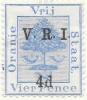 |
Great Britain has a fascinating philatelic history since the introduction of the adhesive stamp in 1840. The period before this reform is equally fascinating.
Here's a prepaid cover from Plymouth to London in the winter of 1828.
It was sent to R[obert] S[amuel] Palmer, Esq., 1 New Boswell Court, Lincoln's Inn, London. Robert S. Palmer (1800-1891) was a barrister, originally from Devon, who had chambers on a short cul-de-sac against the west wall of Lincoln's Inn.
On the front of the cover there is a manuscript 11 in red ink. This would indicate that the postal rate of 11d from Plymouth to London was paid in advance. This is confirmed by the handwritten p.p'd' [Postage Paid], written in the lower left corner as well as the red single line tombstone postmark marked C / PAID / 20 JA 28 / [1]828. The C in the postmark would be the sorting desk. The single line indicates that it was applied in the morning. [Whitney, 1/32]
The tombstone postmark has a 'pen cancel'. I wonder if this could be considered an early security measure to ensure that the paid tombstone could not be reused?
The inland rate, at the time, for a single sheet letter travelling 170-230 miles was 11d.

On the back of the cover, there is a postmark from Plymouth in black ink - in an arc PLYMOUTH with JAN 21 / [1]8[2]8 / 218. 218 would be the mile marker between Plymouth and London. Again, confirming the postage as 11d.

There is a remnant of a black, wax seal. The word FIDELITY (mirror reversed on the seal itself) is at the top of the impression. Underneath there is a slim, long-tailed hound a common sigil at that time.

The cover is constructed from a single sheet of folded wove paper 37x23cm (Imperial Post Quarto). Using a light-table a watermark is visible reading B.E.& S., BATH, 1825. This would be the De Montalt Mill, Combe Down, Bath. It was owned by John Bally, William Ellen and George Steart. The artist Joseph Mallord William Turner was known to favour their paper. The firm specialized in fine writing and artists' paper.

The inside sheet contains two letters ... both written on the same day, January 20, 1828, at 1 George Place, Plymouth by Thomas and Mary Colby. The first (2 pages) is a friendly covering note to Robert Palmer. The second is a more formal (1 page) letter providing instruction to their two trustees Palmer and Charles William Johnson (in connection with the estate of a relative (which probably explains the black wax). This second letter The shorter, tells their trustees to “sell out the stock belonging to us in the 3 percent Consols and invest the same in the 3½ percent Reduced.”
Why? In 1827 the Treasury converted part of the National Debt into a new 3½% bond issue. Investors could exchange their low-yield 3% Consols (a perpetual, no-maturity, government bond created in 1751 when Parliament consolidated war debts into a single 'stock'. It paid a fixed 3% interest payment every six months) for the new, higher-paying 3½% at par, improving income without touching capital. The Colbys are simply asking Palmer and Johnson to execute that government-backed swap. The stock itself was just an entry on the Bank of England’s ledger. Ownership was transferred by a clerk writing your name in the ledger book. This was the job that Palmer & Johnson were being asked to do for the Colby's. ['Consols' meant Consolidated Annuities]
A nice little pre-paid cover dealing with the housekeeping of a Regency era trust fund. In short, the government got cheaper debt in the long run while investors enjoyed an immediate boost in income.
That's one of the reasons I like postal history. It's a fossil record of the grand sweep of history and how it affected the daily lives of the people who lived through it.
|

|
|
| Cross-written Postcards and Letters |
|
Posted by: Hugh - 05-08-2025, 11:07 AM - Forum: Stamps / covers discussion
- Replies (4)
|
|
Cross-writing is when a writer gets to the bottom of a page, or the space available for writing on a postcard, and has more to say. So, he or she turns the page ninety degrees and keeps writing over what has already been written. It one of my collecting interests ... and I'm always looking for new examples.
Here's one I found recently.
It was sent from Hardwick, Vermont to Laconia, New Hampshire on July 16 probably in 1908.
The date is not clear on the duplex cancel .. it looks to me like it's either 1903 or 1908. However, this is a divided back postcard and that format was not allowed in the United States until March 1, 1907. So, I'm going to go with 1908.
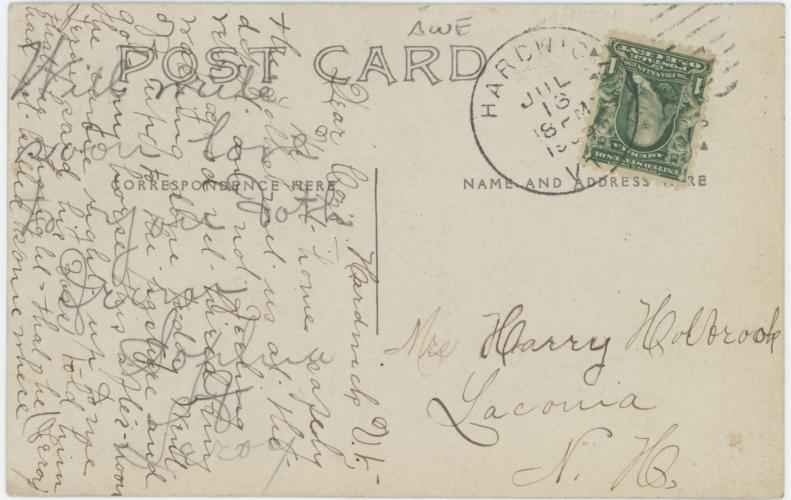
Hardwick was a small granite-quarry town on the Boston and Maine railway line. The card was addressed to Mrs. Harry Holbrook. 'Cuz' in the salutation confirms a family connection.
Laconia was about 115 miles south of Hardwick.
Stamp:
US - Benjamin Franklin
Issued on February 3, 1903
1c, green
Sc. 300
The then current domestic postcard rate was 1c.
Cancel: Single Ring Duplex
Outer ring - HARDWICK / VT
Inner - JUL / 13 / 8 PM / 190[8]
Postcard:
A privately published Real Photo Postcard (RPPC) showing a well-dressed couple in a four-wheeled open runabout (buggy). [Sophie and Leroy? See below]
Written on the photo, is the word 'Kernal' ... probably the name of the horse. The man is wearing a straw hat, a sack suit and a bow-tie. The woman is wearing a 'merry-widow' hat with a plume. Kodak introduced the 'Brownie' camera around 1900 and US postal regulations allowed privately printed RPPCs by 1904.
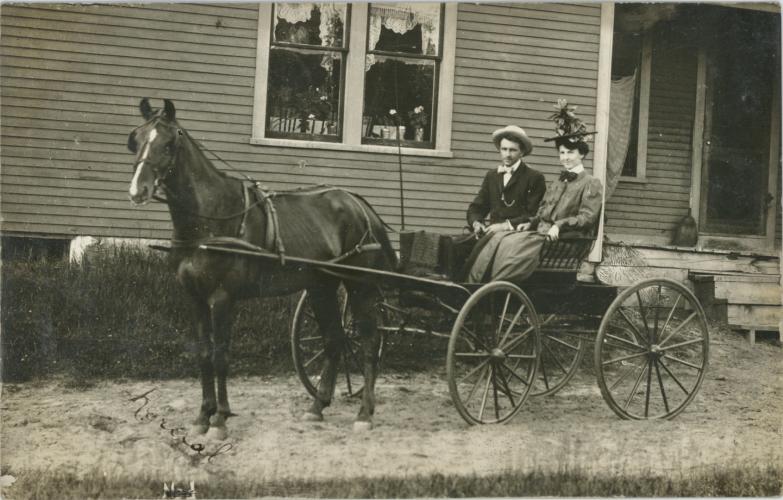
 Image 38.jpeg (Size: 32.44 KB / Downloads: 78)
Message:
The message is cross written to add more content but, to make it easier to read, the horizontal portion of the message was written in pen with a dark ink and the vertical portion was written in pencil.
The message reads:
[vertical]
Hardwick Vt.
Dear Coz,
We got home safely. The folks met us at the depot.
Am not feeling very good yet - tired from walking home today.
Went up to the pasture and got my horse this afternoon;
He came right up to me.
Leroy said his boss told him that he thought he had got killed somewhere
[horizontal]
Will write soon.
Love to you both.
From Sophie and Leroy.
Cheers, Hugh
|
|
|
|
| Free German Album Pages |
|
Posted by: Hugh - 05-08-2025, 10:53 AM - Forum: Europe
- Replies (1)
|
|
If you're looking for German album pages ... here is a truly amazing resource.
Absolutely stunning pages for Imperial Germany, its colonies, its offices abroad, the Weimar Republic and the period from 1933 to 1945. Official stamps, military .. it's all there. New additional pages on speciality topics (e.g. cancellations) are added frequently and you can download all of it for free. The PDF files come in several types ... with and without photos of the stamps, 8.5x11 as well as several popular album sizes.
I use them myself and I've corresponded with the person who created them. It's his passion ... and it's a fantastic contribution to philately.
Check them out:
https://www.germanstamps.net/germanstamp...bum-pages/
|
|
|
|
| Post WW2 Occupied Germany: Soviet Zone |
|
Posted by: Hugh - 05-08-2025, 10:39 AM - Forum: Stamps / covers discussion
- No Replies
|
|
On a March 26, 1948 cover from the Soviet Occupation Zone, I came across this interesting CDS. Never having seen one before, I was smitten by the clock dial in the centre. I wondered if it was a new way of time stamping the cancel?

Yes and No. Time stamp, yes. New, no.
In researching the cancel on Philastempel-Datenbank, I found many similar versions going back to the late 1920s from the same town [EKU 1922]. It was in use during the Weimar Republic, the Third Reich and during the post-war occupation. So, while it was new to me, it seems to have been in use for a long time in Glashütte -- a relatively small town in Saxony (pop. 7,000).
Glashütte is known as the birthplace of the German watchmaking industry. And, that's what this longstanding 'fancy' version of the usual German double ring and bar cancel is all about.
Cancel:
Wide double rings, bar, and 24-hour clockface (35mm / black ink)
Between the rings, Upper -- (10a) GLASHÜTTE / (SACHS) [10 is the two-character German postal routing code for Saxony introduced on July 25, 1941 and retained, for a time, after the war.
Between the rings, Lower -- Feinmechanik / Uhren, Rechenmaschinen [Precision mechanics, watches, calculating machines]
Central bar -- 26.3.48, -17 [March 26, 1948, ~5PM]
Clockface [dial with with hours from 13 to 24. This version of the stamp was used for the afternoon post. Before stamping the dial was moved to the current time. In this case 16:30h]
In short, this is a Orts Werbestemple [local advertising hand-stamp] with a clock motif .. with a three-word resume of the town's expertise.
There are two strikes of this cancel on the follwoing cover. It was sent by Werner Linke to Schaubek-Verlag in Leipzig (Soviet Occupation Zone). Schaubek-Verlag, known for producing the first German Stamp Album in 1862, was re-establishing itself as a printer and publisher of stamp albums after shutting down production during the war due to lack of paper.
Stamps:
1st Control Commission Joint Occupation Issue: Germany
Numeral
Issued on April 19, 1946
2Pf, Black (x2)
Mi.Nr. 912
2nd Control Commission Joint Occupation Issue: Germany
The Sower
Issued on February 1, 1948
10Pf, Yellow-green (x2)
Mi.Nr. 946
The total postage paid was 24Pf. In the Soviet Zone, 24Pf was the rate for a regional letter less than 100g.

|
|
|
|
| WW1 / France: Mail Sent to POW |
|
Posted by: Hugh - 05-08-2025, 10:29 AM - Forum: Stamps / covers discussion
- Replies (3)
|
|
Another fifty-cent card purchased at a club meeting.
It was posted in France and has a single ring CDS that reads CRÉCY EN PONTHIEU / SOMME inside the ring and 8. -8 in the centre. Contextual evidence suggests the year was 1915.

As near as I can make out it was addressed in French as follows ...
Correspondance des prisonniers de Guerre
[Correspondence for Prisoners of War]
au Soldat de Neuil Henri [To Solider Henri de Neuil]
sapeur du 3ème Génie, Cie 4/4
[Sapper, 3rd Engineer Corps, Company 4/4]
Interné au Camp de
[Interned at the Camp at]
Friedrichsfeld, Baraque 5
[Friedrichsfeld, Barrack 5]
Wesel, N° 2208 [Wesel, No. 2208]
(Prusse Rhénane) via Pontarlier [Rhenish Prussie, via Pontarlier]
There is a lot to unpack here. A woman named Catherine is writing to Henri, her younger brother, a French soldier who is interned at Friedrichsfeld POW camp in Germany during World War I. She writes,
Mareesquelt, le 8 août 1915
Cher petit frère,
Sommes heureux d’avoir reçu ta carte de bonne santé.
C’est nous souhaitons qu’elle te trouve de même.
Je t'envoie un mandat ce Mardi.
Notre frère Charles et
notre Grand père, grand’mère, tantes, les cousins ainsi
que ta sœur Marcelle t’embrassent.
Je termine en t’embrassant bien fort.
Ta sœur qui pense à toi,
Catherine
[Maresquel, August 8, 1915
Dear little brother,
We were happy to receive your card letting us know you're in good health.
We hope this one finds you in the same condition.
I’m sending you a money order this Tuesday.
Our brother Charles, our grandfather, grandmother, aunts, cousins, and your sister Marcelle all send their love.
I’ll close now, embracing you warmly.
Your sister who is always thinking of you,
Catherine]
Maresquel was about 25 kilometers from where the card was postmarked.
The letter is being sent to the German POW camp via Switerzland. As can be seen, it is being routed to the French town of Pontarlier. From there, it will be moved across to the border to the International Committee of the Red Cross in Switzerland (ICRC) who as a neutral party, will facilitate the POW mail exchange between France and Germany. In August 1914, the ICRC established l'Agence Internationale des Prisonniers de Guerre [International Agency for Prisoners of War] in Geneva. Each side maintained the right to inspect and censor mail.
On the message side we can see on the lower right a blue hand-stamp. This is a censor mark from the authorities at the Friedrichsfeld Camp. I can make out part of the printed text (Friedrichsfeld) confirming it was applied to the card at the camp.
Kriegsgefangenenlager Friedrichsfeld was a significant German POW camp during WW1. It was one of the larger camps and was located near the town of Wesel, in the Rhineland region (then known as Prussian Rhineland or "Prusse Rhénane"), close to the Rhine River. This area is in present-day North Rhine-Westphalia, Germany.
There is a handwritten 5B at the upper right in the same ink colour as the rest of the message. Catherine was probably numbering her messages.
The picture side of the card shows a photo titled: MARCHEVILLE (Somme). — Entrée de Marcheville sur Danvast.
The Publisher appears to be Lèon Cueillez of Marcheville.

It's truly amazing what you can squeeze out of an old postally-used postcard.
|
|
|
|
|