| Welcome, Guest |
You have to register before you can post on our site.
|
| Online Users |
There are currently 110 online users.
» 0 Member(s) | 106 Guest(s)
Applebot, Baidu, Bing, Google
|
| Latest Threads |
Kingston Stamp Festival O...
Forum: Upcoming Events
Last Post: Carmen
24-10-2026, 07:04 AM
» Replies: 2
» Views: 361
|
New Canada Post Stamps of...
Forum: Canada
Last Post: Carmen
30-08-2026, 06:30 AM
» Replies: 1
» Views: 395
|
Newest acquisition
Forum: United States of America
Last Post: RICHARD
24-08-2026, 07:06 PM
» Replies: 3
» Views: 3,193
|
Summer Newsletter shoutou...
Forum: KSC Lounge
Last Post: Carmen
18-08-2026, 05:53 AM
» Replies: 2
» Views: 507
|
Coming Soon - Eastern Ont...
Forum: Upcoming Events
Last Post: Carmen
12-08-2026, 06:24 AM
» Replies: 1
» Views: 364
|
RE: Columbian stamps 1893
Forum: For Sale
Last Post: RICHARD
20-07-2026, 09:27 PM
» Replies: 0
» Views: 414
|
Private Messages Notifica...
Forum: How to Use This Discussion Board
Last Post: Carmen
20-07-2026, 06:04 AM
» Replies: 2
» Views: 736
|
Wonderful Canadian Cinder...
Forum: Canada
Last Post: Carmen
13-07-2026, 07:37 AM
» Replies: 1
» Views: 577
|
Canada Suspend Service to...
Forum: Our Members Share Philatelic Links
Last Post: GGelinas
10-07-2026, 02:16 PM
» Replies: 2
» Views: 769
|
Argentina: Stamps and Cov...
Forum: Central and South America and Mexico
Last Post: Hugh
04-07-2026, 09:45 AM
» Replies: 0
» Views: 482
|
|
|
| Great Britain Penny Reds : A short tutorial |
|
Posted by: Webmaster - 16-08-2025, 07:44 AM - Forum: United Kingdom and British Colonies / Commonwealth
- Replies (3)
|
 |
Great Britain Penny Reds : A short tutorial
This series of stamps, in use from 1841 to about 1880 causes a lot of headaches, and mis-identifications.
Here are the three basic types:
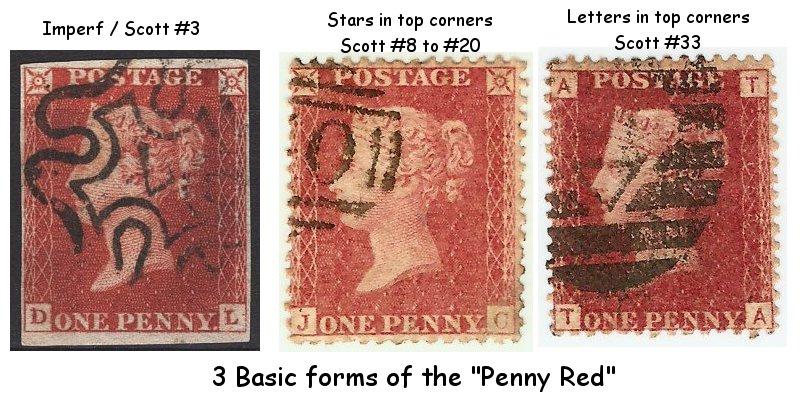
Once you have learned to look at the upper corners first, the first one (#3) and last one (#33) do not present much of a problem. This tutorial is exclusively about the more complicated middle issue, Scott #8 to #20, with stars in the upper corners.
In my mind, if you have had a problem with these issues, it is not you, it Is the catalogue's fault! They seem to go higgly piggly all over the place -- but there is an underlying logic that can streamline identification.
The "set" has 4 basic properties, which show up in various combinations. If we pursue the properties in a logical order, everything becomes easy. These properties are:
Perforation : Either 14 or 16
Watermark: Either small crown (Scott wmk 18 = SG wmk 2) or Large crown (Sc wmk 20 = SG wmk 4) (See below)
Die : either original (equals SG die I) or re-engraved ( equals SG Die II) (See below)
Paper : either white or bluish (with varying depth of blue)
(SG means "Stanley Gibbons catalogue").
Sounds complicated, but it's not! Here's a useful ID table:
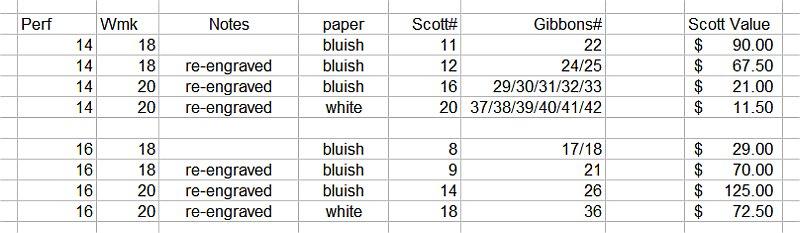
Here's the routine. Start with the perf gauge: 14 or 16? That puts you immediately into the top half or bottom half of the table, with only 4 choices now.
Next is the watermark: Small crown (18) or large crown (20)? Now you are down to 2 choices! Now the final narrowing down to one stamp may depend on either re-engraved or not, or bluish paper or not, but never both.
For example: Let's say your stamp is perf 16, wmk 20 (large crown). Only two choices for that combo, both of which are re-engraved -- either white (Scott #14) or bluish paper (Scott #18). Could it be much easier?
How about: perf 14, wmk 18 (small crown). Now you will see two choices again, both on bluish paper - the original die, and the re-engraved. Pull out your 10x magnifier and check the face -- that's it!
Here is the "close-up stuff" you are going to need:
 gb-penny-03.jpg (Size: 78.76 KB / Downloads: 148)
gb-penny-04.jpg (Size: 36.25 KB / Downloads: 148)
gb-penny-05.jpg (Size: 123.73 KB / Downloads: 147)
Note that I have ignored the Scott sub-numbers ("a", "b"). These are mostly colour shades. Gibbons gives most of these colour shades major numbers. That's why one Scott number translates to as many as 6 Gibbons numbers. In my mind, it is a great error for a novice collector to concentrate on colour for identification. Colours change over time. The red pigment in these stamps contains iron, and is subject to oxidation (rust). Frequently, there are many printings that are slightly different in colour, but are considered still be be colour "A", whereas to the novice, he/she sees a slightly different colour and thinks "one of them MUST be the better shade!". -- not so! Colours are best left to long experience, or verification by experts. (This is the subject of a whole 'nother tutorial). If you have never actually seen a correctly identified "orange red" vs. a "brick red" vs a "red brown", don't believe for a minute that you can tell the difference from word descriptions!
Now attack your penny reds! I hope this tutorial will make it easier for you.
Roy
|

|
|
| Canada: Engraved Stamps |
|
Posted by: Hugh - 14-08-2025, 04:38 PM - Forum: Canada
- Replies (2)
|
 |
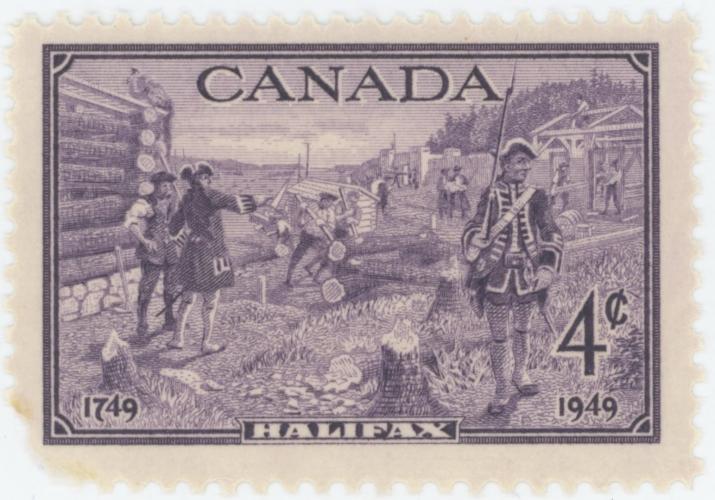
Stamp:
Canada: Halifax Bicentenary
The founding of Halifax
Based on a painting by Charles William Jefferys
Issued on June 21, 1949
4c, Purple, engraved
Unitrade 283
Edward Cornwallis ... born on March 5, 1713. One of his grandfathers was First Lord of the Admiralty, the other was Governor of Ireland.
He was a twin. The family's plan was that one of the brothers would enter the church, one the military. But which one? When his brother fell from a horse and paralysed his arm., Edward, at 18, was commissioned into the army.
A career soldier, he fought for Cumberland at the Battle of Culloden in 1745 and was tasked, after the battle, with leading a regiment into the Highlands to 'pacify' Lochabar.
He was appointed Governor of Nova Scotia in 1749 and established the port town and fortifications of Halifax. He ended his career as a Lt. General and as the Governor of Gibraltar. He died in 1776.
His Nephew, Charles Cornwallis, commanded the British troops at Yorktown.
|
|
|
|
|