
In theory, this is a fairly ordinary Yugoslav commercial cover.
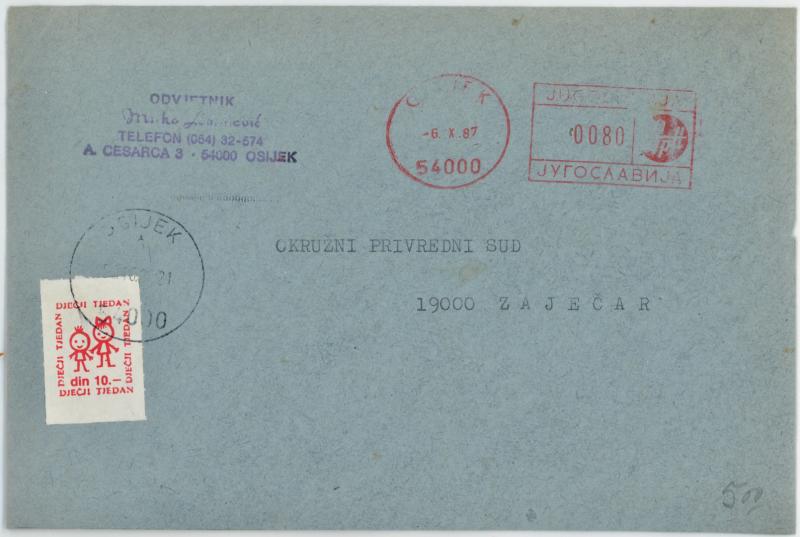
It was mailed from Osijek, in the Socialist Republic of Croatia, on October 6, 1987, to the Okružni Privredni Sud / District Commercial Court in Zaječar, in the Socialist Republic of Serbia. The sender was a lawyer in Osijek. The red meter impression paid 80 dinars Yugoslav postage.
As I said, on one level, ordinary commercial mail.
The context, however, is interesting. By 1987, Yugoslavia had moved well beyond ordinary inflation. World Bank/IMF series put average CPI inflation for 1987 at about 121%, while the December-to-December increase was about 169%. That means prices were, on average, more than doubling over the year. Next year, in 1988 inflation would accelerate further to roughly 194% on an annual-average basis, and in 1989 Yugoslavia entered true hyperinflation, with annual rates in the thousands of percent.
The 80-dinar domestic letter rate had been introduced on July 24, 1987. It would last less than four months: on November 15 the rate rose again, to 106 dinars.
The causes were structural and financial. There was also a political economy chalenge. Yugoslavia’s decentralized system made it difficult to impose hard budget constraints on enterprises, banks and republics. Losses could be shifted around the federation rather than resolved. The World Bank later described this as a process in which enterprise and banking losses, regional disparities, subsidized credit and wage indexation reinforced one another.
Politically, Yugoslavia in 1987 was still the Socialist Federal Republic of Yugoslavia, a one-party socialist federation governed by the League of Communists. It consisted of six republics: Slovenia, Croatia, Bosnia and Herzegovina, Serbia, Montenegro and Macedonia plus the autonomous provinces of Kosovo and Vojvodina (within Serbia).
This cover shows some of the complexities at a mundane postal level.
Notice the red and white label at the lower left.
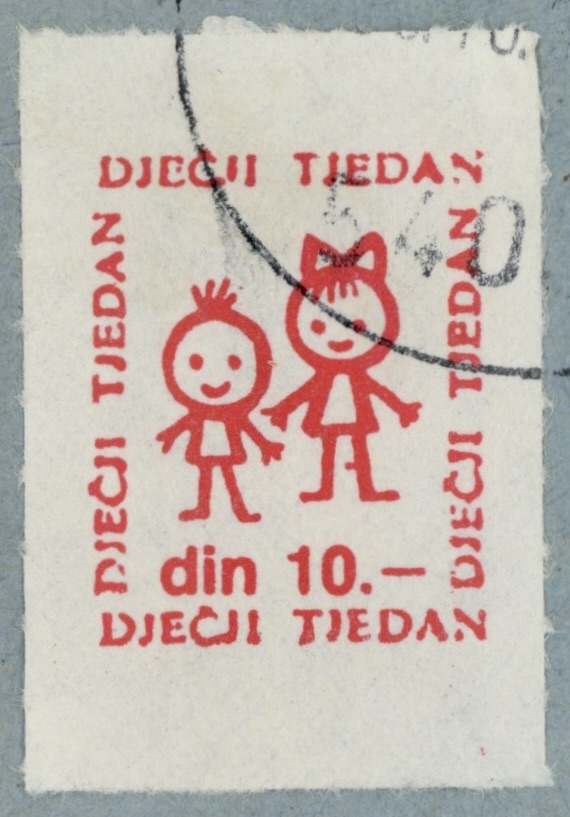
It reads: DJEČJI TJEDAN / din 10. = Children’s Week / 10 dinars.
It was a 'doplatna marka' ... a compulsory surcharge stamp Under Croatian legislation, 'Children’s Week' was held during the first week of October. During that time, a special contribution for child welfare was collected on a number of transactions, including all domestic postal items. Like this one ... essentially a postal tax stamp.
The label has been separately cancelled with an OSIJEK circular date stamp in black ink, preventing its reuse and showing that the required surcharge had been paid. The actual postage was the 80 dinars from the meter impression. The additional 10 dinars was a compulsory contribution.
So, the meter impression was authorized by the federal Yugoslav postal system ... JUGOSLAVIJA / ЈУГОСЛАВИЈА and the Yugoslav PTT. The compulsory Children’s Week contribution, however, was imposed under legislation of the Socialist Republic of Croatia. In 1987 the federation still functioned; the postal system certainly did, as this Osijek-to-Zaječar cover demonstrates. It is also a small example of the federal structure in practice: federal Yugoslav postage alongside a surcharge imposed under Croatian republican legislation.
Cheers, Hugh
It was mailed from Osijek, in the Socialist Republic of Croatia, on October 6, 1987, to the Okružni Privredni Sud / District Commercial Court in Zaječar, in the Socialist Republic of Serbia. The sender was a lawyer in Osijek. The red meter impression paid 80 dinars Yugoslav postage.
As I said, on one level, ordinary commercial mail.
The context, however, is interesting. By 1987, Yugoslavia had moved well beyond ordinary inflation. World Bank/IMF series put average CPI inflation for 1987 at about 121%, while the December-to-December increase was about 169%. That means prices were, on average, more than doubling over the year. Next year, in 1988 inflation would accelerate further to roughly 194% on an annual-average basis, and in 1989 Yugoslavia entered true hyperinflation, with annual rates in the thousands of percent.
The 80-dinar domestic letter rate had been introduced on July 24, 1987. It would last less than four months: on November 15 the rate rose again, to 106 dinars.
The causes were structural and financial. There was also a political economy chalenge. Yugoslavia’s decentralized system made it difficult to impose hard budget constraints on enterprises, banks and republics. Losses could be shifted around the federation rather than resolved. The World Bank later described this as a process in which enterprise and banking losses, regional disparities, subsidized credit and wage indexation reinforced one another.
Politically, Yugoslavia in 1987 was still the Socialist Federal Republic of Yugoslavia, a one-party socialist federation governed by the League of Communists. It consisted of six republics: Slovenia, Croatia, Bosnia and Herzegovina, Serbia, Montenegro and Macedonia plus the autonomous provinces of Kosovo and Vojvodina (within Serbia).
This cover shows some of the complexities at a mundane postal level.
Notice the red and white label at the lower left.
It reads: DJEČJI TJEDAN / din 10. = Children’s Week / 10 dinars.
It was a 'doplatna marka' ... a compulsory surcharge stamp Under Croatian legislation, 'Children’s Week' was held during the first week of October. During that time, a special contribution for child welfare was collected on a number of transactions, including all domestic postal items. Like this one ... essentially a postal tax stamp.
The label has been separately cancelled with an OSIJEK circular date stamp in black ink, preventing its reuse and showing that the required surcharge had been paid. The actual postage was the 80 dinars from the meter impression. The additional 10 dinars was a compulsory contribution.
So, the meter impression was authorized by the federal Yugoslav postal system ... JUGOSLAVIJA / ЈУГОСЛАВИЈА and the Yugoslav PTT. The compulsory Children’s Week contribution, however, was imposed under legislation of the Socialist Republic of Croatia. In 1987 the federation still functioned; the postal system certainly did, as this Osijek-to-Zaječar cover demonstrates. It is also a small example of the federal structure in practice: federal Yugoslav postage alongside a surcharge imposed under Croatian republican legislation.
Cheers, Hugh
Hugh MacDonald, Wolfe Island
Member: BNAPS. PHSC, MPHS, FPHS, CSS
Auxiliary Markings Club, Postal Stationery Society, British Postmark Society,
Civil Censorship Study Group
ArGe Deutsche Feldpost: 1914-1918 e.V.
Member: BNAPS. PHSC, MPHS, FPHS, CSS
Auxiliary Markings Club, Postal Stationery Society, British Postmark Society,
Civil Censorship Study Group
ArGe Deutsche Feldpost: 1914-1918 e.V.