
Here is an interesting label I picked up at the club meeting last week.
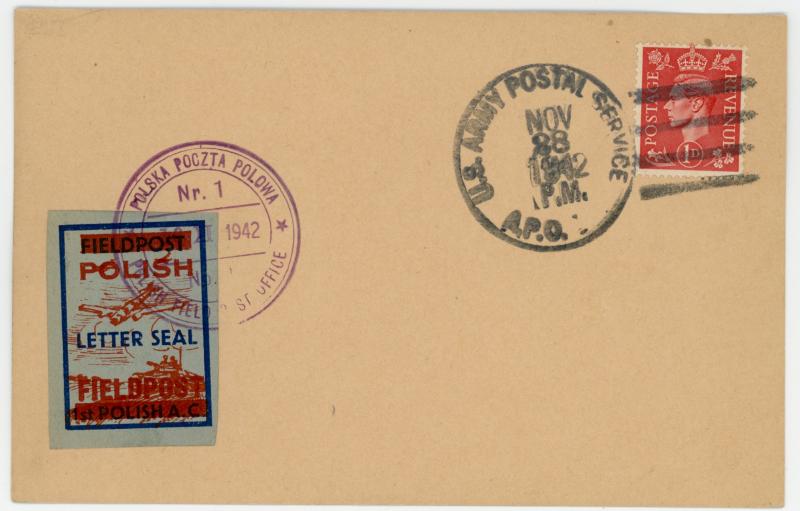
It's marked FIELDPOST / POLISH / LETTER SEAL / FIELDPOST / 1st POLISH A.C. (= Army Corps). I actually think that the original seal said FIELDPOST / LETTER SEAL / 1st POLISH A.C ... with FIELDPOST and 1st POLISH A.C. in black ink and LETTER SEAL in blue ink. Then, later, it was overprinted (see later in this post).
Like your Norwegian example, earlier in the thread, it is clearly philatelic, a souvenir for a collector I suppose.
The card has a KGVI 1d British definitive tied to an un-numbered US Army Postal Service CDS with a four-bar obliterator in black ink. It's dated November 28, 1942. This places it during the period when APO numbers were ordered removed from postal cancellations effective July 1, 1942, for security reasons. This order remained in effect until March 10, 1943.
The English-language postal label is tied to a purple double-circle bilingual Polish Field Post Office No. 1 datestamp.
POLSKA POCZTA POLOWA
Nr. 1
30 XI 1942
POLISH FIELD POST OFFICE
Alfred F. Kugel's exhibit, Polish Forces in Exile During and Following World War II, indicated that this double-circle, bilingual CDS was introduced in Great Britain in November 1942.
As for the label, I found an interesting article by Jerry Piotrowski … Letter labels of the WWII Polish Forces in England. It was published in PhilaJournal, Spring 2019, pp. 7–8.
In it, Piotrowski attributes the production of these seals to Aleksander Stocki (1897–1960), a Polish army officer with a background in military cartography and stamp dealing. He had started a mail-order stamp business in Warsaw in 1926 and, according to Piotrowski, “ … in 1927 resigned his commission in the army allegedly due to being accused of forging flight labels. Following the invasion of Poland in 1939 he was called back into the army.”
Stocki reached Scotland by mid-1940. Around late 1941 he began producing pictorial and other seals supposedly intended to secure mail that had been opened or damaged in transit. His access to Polish Army printing facilities apparently made this possible. Piotrowski specifically reports that Stocki produced his own cancellation hand-stamps for philatelic souvenirs.
The article noted that although the labels had a plausible military postal purpose, their documented use was overwhelmingly philatelic. Piotrowski questions whether genuinely operational examples of the resealing labels even exist.
Source: gtapa.greenefoundationarchive.ca/pdf/2018-19/PhilaJournal-WN.67-Vol.XVII-No.3-2.pdf
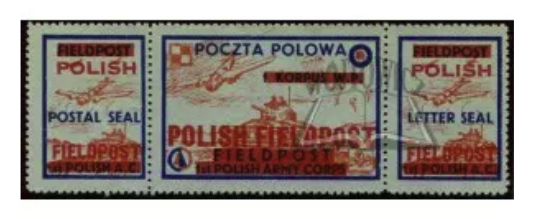
The label on my souvenir card appears to have a red overprinted bar crossing out the word FIELDPOST at the top and 1st POLISH A.C. on the bottom and adding, in red, the words POLISH above the blue LETTER SEAL and FIELDPOST below. This appears to have been an effort to convert the earlier label for the 1st Polish Army Corps into a more generic version.
I found a copy of the same overprinted label in a 2020 auction listing. Here's an image from the auction catalogue.
Source: onebid.pl/pl/znaczki-polska-emigracja-poczta-polowa-1-korpus-w-p-polish-fieldpost-1st-polish-army-corps-fieldpost-polish-letter-seal-1st-polish-a-c/677067
Cheers, Hugh
It's marked FIELDPOST / POLISH / LETTER SEAL / FIELDPOST / 1st POLISH A.C. (= Army Corps). I actually think that the original seal said FIELDPOST / LETTER SEAL / 1st POLISH A.C ... with FIELDPOST and 1st POLISH A.C. in black ink and LETTER SEAL in blue ink. Then, later, it was overprinted (see later in this post).
Like your Norwegian example, earlier in the thread, it is clearly philatelic, a souvenir for a collector I suppose.
The card has a KGVI 1d British definitive tied to an un-numbered US Army Postal Service CDS with a four-bar obliterator in black ink. It's dated November 28, 1942. This places it during the period when APO numbers were ordered removed from postal cancellations effective July 1, 1942, for security reasons. This order remained in effect until March 10, 1943.
The English-language postal label is tied to a purple double-circle bilingual Polish Field Post Office No. 1 datestamp.
POLSKA POCZTA POLOWA
Nr. 1
30 XI 1942
POLISH FIELD POST OFFICE
Alfred F. Kugel's exhibit, Polish Forces in Exile During and Following World War II, indicated that this double-circle, bilingual CDS was introduced in Great Britain in November 1942.
As for the label, I found an interesting article by Jerry Piotrowski … Letter labels of the WWII Polish Forces in England. It was published in PhilaJournal, Spring 2019, pp. 7–8.
In it, Piotrowski attributes the production of these seals to Aleksander Stocki (1897–1960), a Polish army officer with a background in military cartography and stamp dealing. He had started a mail-order stamp business in Warsaw in 1926 and, according to Piotrowski, “ … in 1927 resigned his commission in the army allegedly due to being accused of forging flight labels. Following the invasion of Poland in 1939 he was called back into the army.”
Stocki reached Scotland by mid-1940. Around late 1941 he began producing pictorial and other seals supposedly intended to secure mail that had been opened or damaged in transit. His access to Polish Army printing facilities apparently made this possible. Piotrowski specifically reports that Stocki produced his own cancellation hand-stamps for philatelic souvenirs.
The article noted that although the labels had a plausible military postal purpose, their documented use was overwhelmingly philatelic. Piotrowski questions whether genuinely operational examples of the resealing labels even exist.
Source: gtapa.greenefoundationarchive.ca/pdf/2018-19/PhilaJournal-WN.67-Vol.XVII-No.3-2.pdf
The label on my souvenir card appears to have a red overprinted bar crossing out the word FIELDPOST at the top and 1st POLISH A.C. on the bottom and adding, in red, the words POLISH above the blue LETTER SEAL and FIELDPOST below. This appears to have been an effort to convert the earlier label for the 1st Polish Army Corps into a more generic version.
I found a copy of the same overprinted label in a 2020 auction listing. Here's an image from the auction catalogue.
Source: onebid.pl/pl/znaczki-polska-emigracja-poczta-polowa-1-korpus-w-p-polish-fieldpost-1st-polish-army-corps-fieldpost-polish-letter-seal-1st-polish-a-c/677067
Cheers, Hugh
Hugh MacDonald, Wolfe Island
Member: BNAPS. PHSC, MPHS, FPHS, CSS
Auxiliary Markings Club, Postal Stationery Society, British Postmark Society,
Civil Censorship Study Group
ArGe Deutsche Feldpost: 1914-1918 e.V.
Member: BNAPS. PHSC, MPHS, FPHS, CSS
Auxiliary Markings Club, Postal Stationery Society, British Postmark Society,
Civil Censorship Study Group
ArGe Deutsche Feldpost: 1914-1918 e.V.