
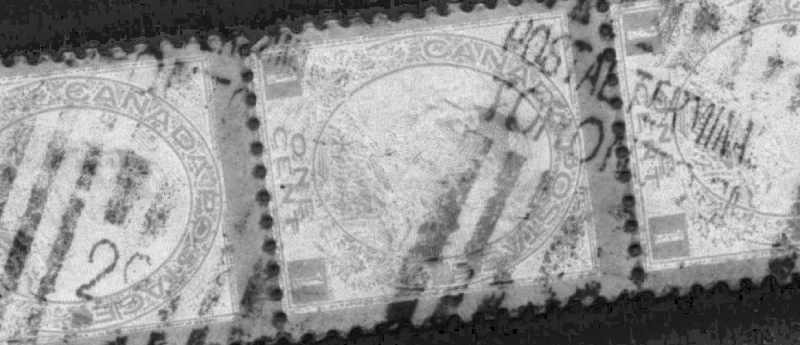
The strikes on this example are less than perfect. It does appear that a Type V B roller with eight bars was used. It appears to read, POSTAL TERMINAL [A?] / TORONTO ON[T] / 29.
The 'A' and the 'T' are not visible, just assumed based on the literature. They would have been positioned at the eight bar .. which is not visible. As for the number - 29, Smythies recorded, I understand, 38 terminal rollers numbered 25 to 62. These terminals were not independent branch post offices but part of the Toronto Head Office.
Comments are welcome. It may be that the 29 is actually a 25?
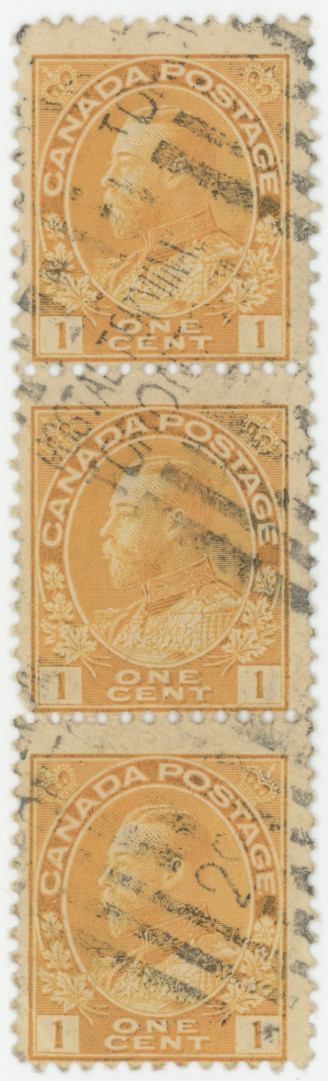
Three rolls of the cancel are tied to a strip of 3 KGV 1c Admirals, Die 1, issued on June 7, 1922 (Unitrade 105)
Cheers, Hugh
The 'A' and the 'T' are not visible, just assumed based on the literature. They would have been positioned at the eight bar .. which is not visible. As for the number - 29, Smythies recorded, I understand, 38 terminal rollers numbered 25 to 62. These terminals were not independent branch post offices but part of the Toronto Head Office.
Comments are welcome. It may be that the 29 is actually a 25?
Three rolls of the cancel are tied to a strip of 3 KGV 1c Admirals, Die 1, issued on June 7, 1922 (Unitrade 105)
Cheers, Hugh
Hugh MacDonald, Wolfe Island
Member: BNAPS. PHSC, MPHS, FPHS, CSS
Auxiliary Markings Club, Postal Stationery Society, British Postmark Society,
Civil Censorship Study Group
ArGe Deutsche Feldpost: 1914-1918 e.V.
Member: BNAPS. PHSC, MPHS, FPHS, CSS
Auxiliary Markings Club, Postal Stationery Society, British Postmark Society,
Civil Censorship Study Group
ArGe Deutsche Feldpost: 1914-1918 e.V.