

04-02-2026, 06:02 PM
Here is an 1811 French field post cover from the Kingdom of Italy.
Though nominally a sovereign state, the Regno d’Italia (1805-1814) was Napoleon’s personal fief. It was garrisoned by French troops, administered under French law, and woven into the Empire’s fiscal, postal, and military networks. In my view, therefore, this cover sits squarely within the wider study of the occupied Départements Conquis.
The manuscript Servizio Militare in the upper right-hand corner, identifies this as military service mail. Like more modern field-post this category of mail was exempt from postage.
Underneath, in red ink, is an oval hand-stamp with the town name REGGIO. Such 'timbro ovale piatto' postmarks were used by the postal system of the Kingdom of Italy since 1806. Essentially it’s an undated receiving or dispatch indicator. Reggio, or Reggio Emilia was the capital of the Kingdom's département or district of Crostolo.
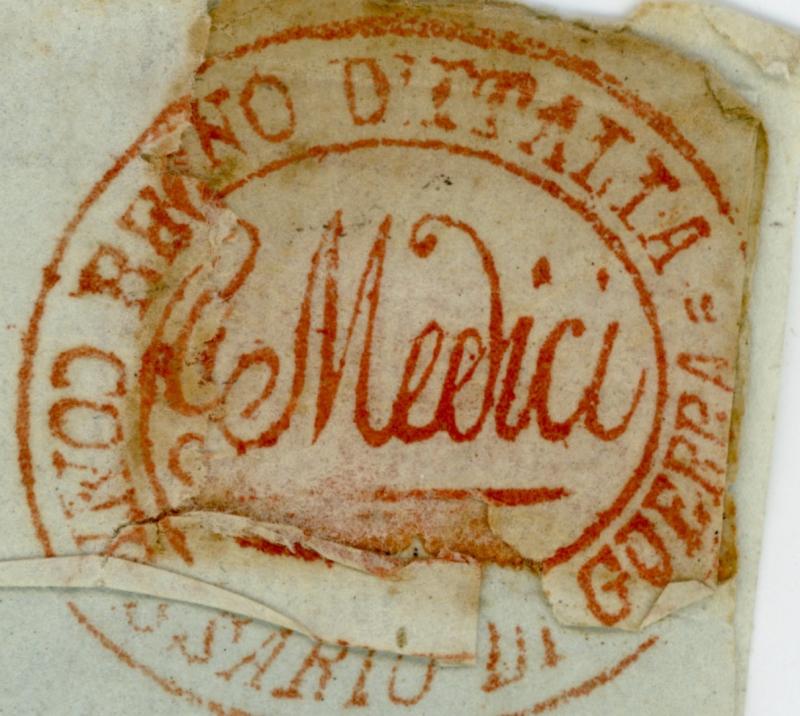
In the bottom left-hand corner is a black manuscript Il Commissario di Guerra Medici [The War Commissioner Medici] and underneath is a red ink oval hand-stamp with two rings. Between the rings is REGNO D’ITALIA / COMMISSARIO DI GUERRA [Kingdom of Italy / War Commissioner]. Inside the oval is the name of the sender G. Medici. That is, Giuseppe Medici. in 1811 he was the Commissario di guerra at Reggio. A Comissario di guerra was a member of the commissariat corps roughly equivalent to a major or lieutenant-colonel in line units. The job involved fiscal authority (auditing, supply contracts, wages) and logistical command at a district level.
The cover was addressed to Congregazione di Carità di Correggio [Congregation of Charity of Corregio / or, the Poor Relief Board]. Why military mail to a charity? During this period, French laws reorganised Congregazioni di Carità as quasi-public welfare agencies. Garrisons or passing units often drew on them for billets for convalescent soldiers, hospital beds for wounded returnees, and help for soldiers’ widows and orphans.

The hand-stamp is repeated on the reverse of the cover, on the top of a wafer seal.
As one would expect, there are no rate marks. The cover would have travelled post-free 22Km from Reggio (Emilia) to Corregio. That's about 3 or 4 hours on horseback. It most likely arrived on the same day it was sent. While we don't know when it was sent (there are no contents) the recipient recorded its arrival on one of the flaps.

[Scritta?] al num. 437 [Entered? under number 437]
li 31 8bre 1811 [on the 31st of October, 1811]
The format of the date is interesting. A decree of 22 Fructidor an XIII (9 Sep 1805) abolished the Republican Calendar in Napoleon’s new Kingdom of Italy. It wasn't implemented until January 1, 1806, to allow a clean start at the beginning of the year. After that, on official and military communications, the Kingdom of Italy used the Gregorian Calendar but with the month abbreviations 'bre' as in 7bre, 8bre, 9bre, Xbre. March was month 1. This was a revival of a shorthand that was common under the ancien régime.
Anyway, we now have a date for the cover. It was probably sent on October 31, 1811.
Using a light-table, we can see that the cover was written on laid paper and has the following watermark.
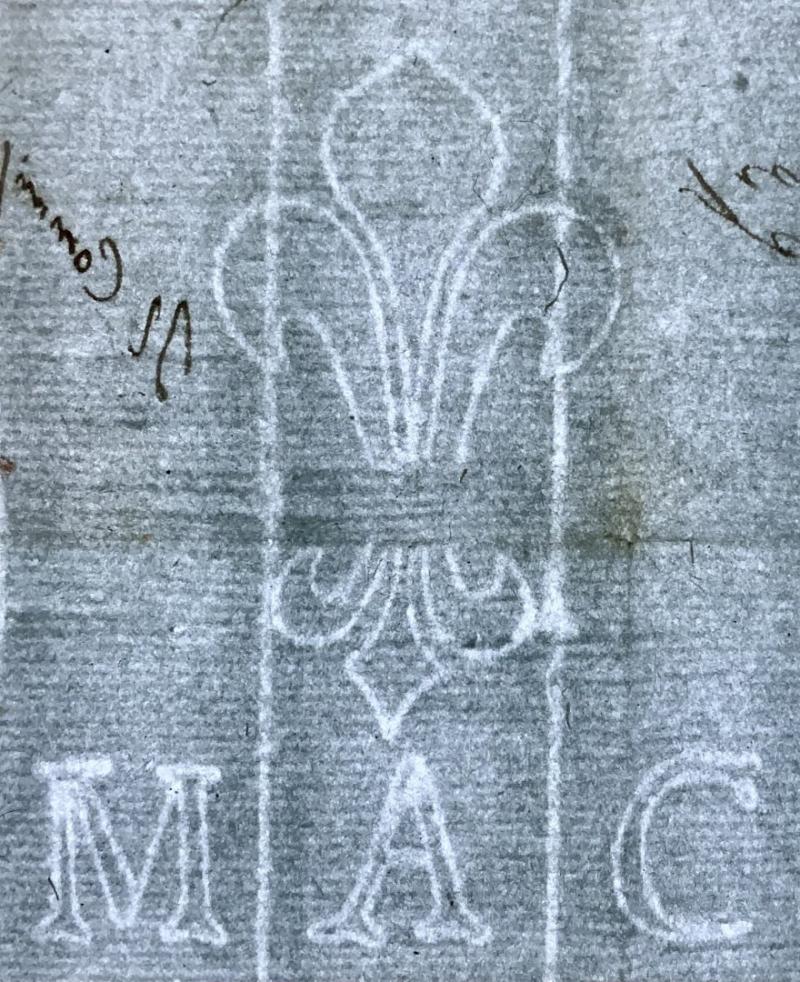
This would appear to be a Florentine giglio [fleur-de-lys] with three roman capitals M A C aligned under the lily. The paper mould has vertical chain-lines about 25mm apart with tight laid lines about 8 per centimeter. This kind of paper was produced in mills around Pescia. If so, then M A C probably stands for Magnani & C[ompagnia]. They were based in Pescia in Tuscany and were known to be active papermakers at this time (and still are today).
The Kingdom, as a dependancy of France did not outlast Napoleon or the collapse of the First French Empire. This cover, however, did.
As always, corrrections, comments and suggestions are more than welcome. Grazie in anticipo! (smile)
Cheers, Hugh
Though nominally a sovereign state, the Regno d’Italia (1805-1814) was Napoleon’s personal fief. It was garrisoned by French troops, administered under French law, and woven into the Empire’s fiscal, postal, and military networks. In my view, therefore, this cover sits squarely within the wider study of the occupied Départements Conquis.
The manuscript Servizio Militare in the upper right-hand corner, identifies this as military service mail. Like more modern field-post this category of mail was exempt from postage.
Underneath, in red ink, is an oval hand-stamp with the town name REGGIO. Such 'timbro ovale piatto' postmarks were used by the postal system of the Kingdom of Italy since 1806. Essentially it’s an undated receiving or dispatch indicator. Reggio, or Reggio Emilia was the capital of the Kingdom's département or district of Crostolo.
In the bottom left-hand corner is a black manuscript Il Commissario di Guerra Medici [The War Commissioner Medici] and underneath is a red ink oval hand-stamp with two rings. Between the rings is REGNO D’ITALIA / COMMISSARIO DI GUERRA [Kingdom of Italy / War Commissioner]. Inside the oval is the name of the sender G. Medici. That is, Giuseppe Medici. in 1811 he was the Commissario di guerra at Reggio. A Comissario di guerra was a member of the commissariat corps roughly equivalent to a major or lieutenant-colonel in line units. The job involved fiscal authority (auditing, supply contracts, wages) and logistical command at a district level.
The cover was addressed to Congregazione di Carità di Correggio [Congregation of Charity of Corregio / or, the Poor Relief Board]. Why military mail to a charity? During this period, French laws reorganised Congregazioni di Carità as quasi-public welfare agencies. Garrisons or passing units often drew on them for billets for convalescent soldiers, hospital beds for wounded returnees, and help for soldiers’ widows and orphans.
The hand-stamp is repeated on the reverse of the cover, on the top of a wafer seal.
As one would expect, there are no rate marks. The cover would have travelled post-free 22Km from Reggio (Emilia) to Corregio. That's about 3 or 4 hours on horseback. It most likely arrived on the same day it was sent. While we don't know when it was sent (there are no contents) the recipient recorded its arrival on one of the flaps.
[Scritta?] al num. 437 [Entered? under number 437]
li 31 8bre 1811 [on the 31st of October, 1811]
The format of the date is interesting. A decree of 22 Fructidor an XIII (9 Sep 1805) abolished the Republican Calendar in Napoleon’s new Kingdom of Italy. It wasn't implemented until January 1, 1806, to allow a clean start at the beginning of the year. After that, on official and military communications, the Kingdom of Italy used the Gregorian Calendar but with the month abbreviations 'bre' as in 7bre, 8bre, 9bre, Xbre. March was month 1. This was a revival of a shorthand that was common under the ancien régime.
Anyway, we now have a date for the cover. It was probably sent on October 31, 1811.
Using a light-table, we can see that the cover was written on laid paper and has the following watermark.
This would appear to be a Florentine giglio [fleur-de-lys] with three roman capitals M A C aligned under the lily. The paper mould has vertical chain-lines about 25mm apart with tight laid lines about 8 per centimeter. This kind of paper was produced in mills around Pescia. If so, then M A C probably stands for Magnani & C[ompagnia]. They were based in Pescia in Tuscany and were known to be active papermakers at this time (and still are today).
The Kingdom, as a dependancy of France did not outlast Napoleon or the collapse of the First French Empire. This cover, however, did.
As always, corrrections, comments and suggestions are more than welcome. Grazie in anticipo! (smile)
Cheers, Hugh
Hugh MacDonald, Wolfe Island
Member: BNAPS. PHSC, MPHS, FPHS, AMGCC, CSS
Auxiliary Markings Club, Postal Stationery Society, British Postmark Society,
Civil Censorship Study Group
ArGe Deutsche Feldpost: 1914-1918 e.V.