

20-11-2025, 12:41 AM
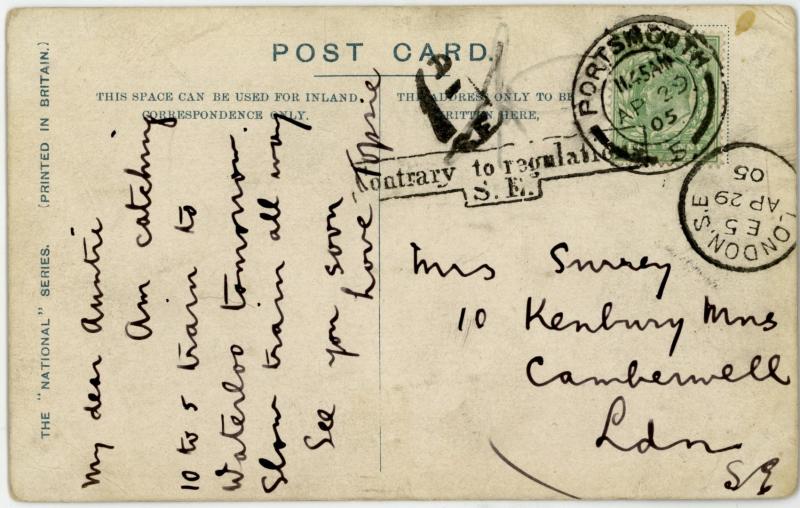
Here's an interesting Edwardian postcard marked Contrary to Regulations / S.E. inside an irregular shaped framw and paired with a 1d / S.E. postage due hand-stamp -- both in black ink.
It was mailed from Portsmouth late in the morning of April 29, 1905 and sent to London, S.E. When it arrived later that day. A south east London postal worker took exception to the glitter used on the picture side of the card and applied the contrary to regulations and postage due hand-stamps.
Stamp:
King Edward VII
Issued on November 26, 1904
½d, Pale Yellowish Green
SG 217
Cancels:
Receiving - Double Circle, medium arc CDS, black ink (Whitney 9/26)
PORTSMOUTH / 5
11:45 AM / AP 29 / 05
Arrival - Single Circle Backstamp, black ink
LONDON.S.E
E 5 / AP 29 / 05
Instructional / Auxiliary Markings
Irregular frame, black ink
Contrary to Regulations / S.E. (Whitney, 18/40)
Postage due oval hand-stamp, black ink
1d / S.E. (Whitney, 18/4)
The UK didn't use postage due stamps until 1914, hence the hand-stamp.
By the early 1900s the British Post Office allowed private picture postcards at the ½d rate, but they were subject to certain physical rules: they had to be on a standard card within set dimensions and thickness, and could not have anything inserted in or attached to the card. The addition of 'glitter' to the card meant the item was no longer a postcard but liable to the letter rate of 1d. Therefore, as seen here, postage due of 1d, double the missing postage, was taxed as postage due.
Here's a link to a similar card offered in a 2024 auction:
https://sgbaldwins.com/auctions/e-sale-g...004/lot/33
Postcard:
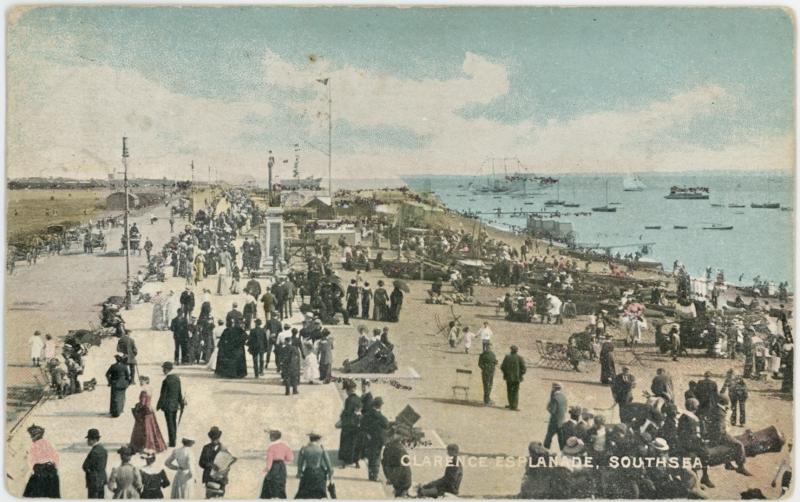
Picture Side Text, Clarence Esplanade, Southsea
Halftone printed photograph with chromolithographic tinting, plus the application of coloured glitter.
The 'National' Series / Printed in Britain [Publisher not indicated]
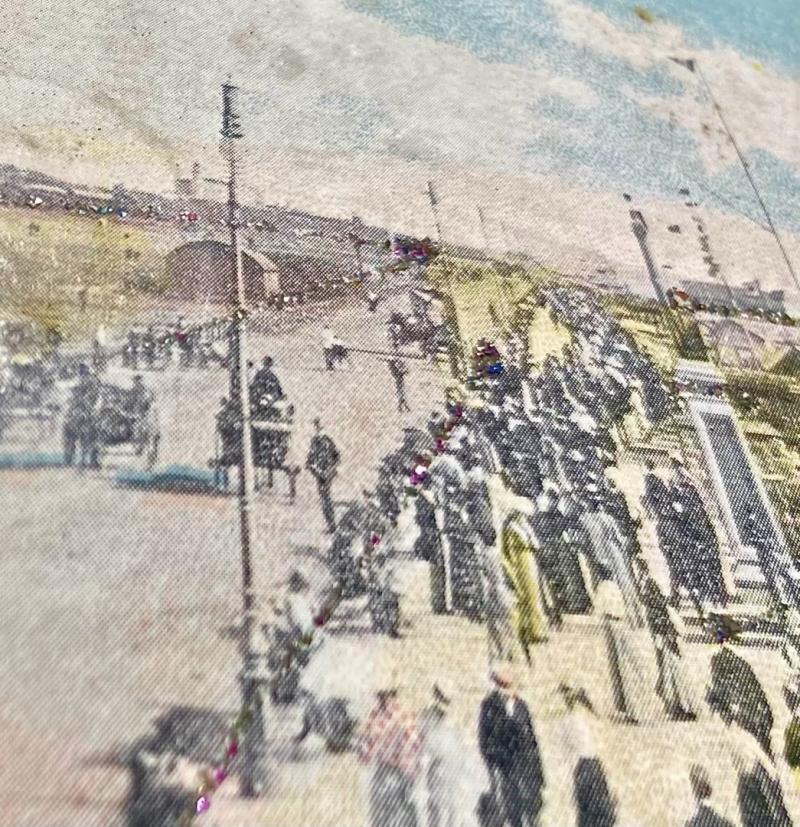
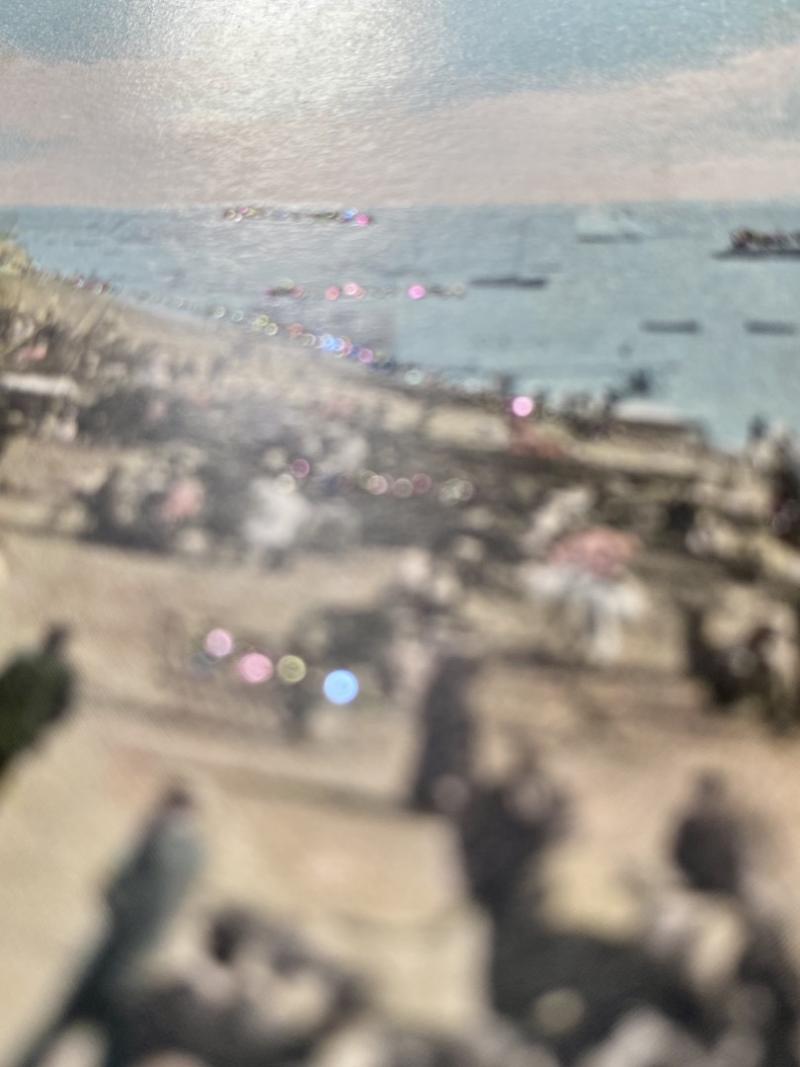
Despite the postal regulations, glitter cards were fairly common -- especially at Christmas and New Year's. Initially, the post office didn't ban them outright they just charged postage due and treated them like a letter. In time, as they gummed up the machinery, glitter cards were sent as enclosures in regular mail, a practice followed to this day. The glitter was made of very fine ground glass and would have been glued on the card by shaking a jar of glitter over gum arabic applied by hand probably using a stencil, or brushed on by hand.
Although the publisher is not indicated on the card, this series is known to have been produced by Millar & Lang, Art Publishing Company founded in 1902 and based in Glasgow. For more information see ... www.edinphoto.org.uk/0_PCV_M/0_post_card_views_national.htm
It's hard to see the glitter in the scan. Here's a couple of close ups.
Cheers, Hugh
It was mailed from Portsmouth late in the morning of April 29, 1905 and sent to London, S.E. When it arrived later that day. A south east London postal worker took exception to the glitter used on the picture side of the card and applied the contrary to regulations and postage due hand-stamps.
Stamp:
King Edward VII
Issued on November 26, 1904
½d, Pale Yellowish Green
SG 217
Cancels:
Receiving - Double Circle, medium arc CDS, black ink (Whitney 9/26)
PORTSMOUTH / 5
11:45 AM / AP 29 / 05
Arrival - Single Circle Backstamp, black ink
LONDON.S.E
E 5 / AP 29 / 05
Instructional / Auxiliary Markings
Irregular frame, black ink
Contrary to Regulations / S.E. (Whitney, 18/40)
Postage due oval hand-stamp, black ink
1d / S.E. (Whitney, 18/4)
The UK didn't use postage due stamps until 1914, hence the hand-stamp.
By the early 1900s the British Post Office allowed private picture postcards at the ½d rate, but they were subject to certain physical rules: they had to be on a standard card within set dimensions and thickness, and could not have anything inserted in or attached to the card. The addition of 'glitter' to the card meant the item was no longer a postcard but liable to the letter rate of 1d. Therefore, as seen here, postage due of 1d, double the missing postage, was taxed as postage due.
Here's a link to a similar card offered in a 2024 auction:
https://sgbaldwins.com/auctions/e-sale-g...004/lot/33
Postcard:
Picture Side Text, Clarence Esplanade, Southsea
Halftone printed photograph with chromolithographic tinting, plus the application of coloured glitter.
The 'National' Series / Printed in Britain [Publisher not indicated]
Despite the postal regulations, glitter cards were fairly common -- especially at Christmas and New Year's. Initially, the post office didn't ban them outright they just charged postage due and treated them like a letter. In time, as they gummed up the machinery, glitter cards were sent as enclosures in regular mail, a practice followed to this day. The glitter was made of very fine ground glass and would have been glued on the card by shaking a jar of glitter over gum arabic applied by hand probably using a stencil, or brushed on by hand.
Although the publisher is not indicated on the card, this series is known to have been produced by Millar & Lang, Art Publishing Company founded in 1902 and based in Glasgow. For more information see ... www.edinphoto.org.uk/0_PCV_M/0_post_card_views_national.htm
It's hard to see the glitter in the scan. Here's a couple of close ups.
Cheers, Hugh
Hugh MacDonald, Wolfe Island
Member: BNAPS. PHSC, MPHS, FPHS, AMGCC, CSS
Auxiliary Markings Club, Postal Stationery Society, British Postmark Society,
Civil Censorship Study Group
ArGe Deutsche Feldpost: 1914-1918 e.V.