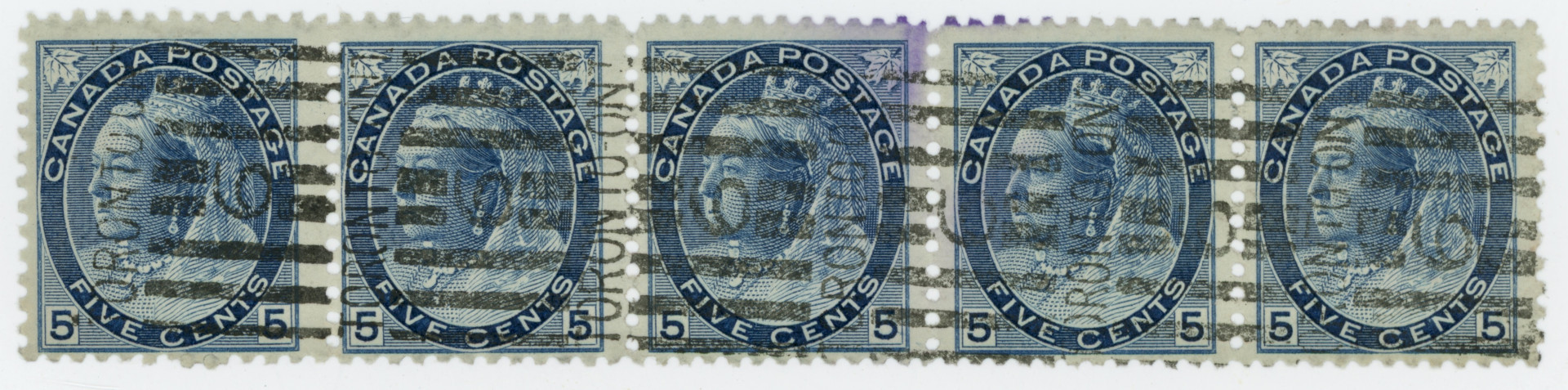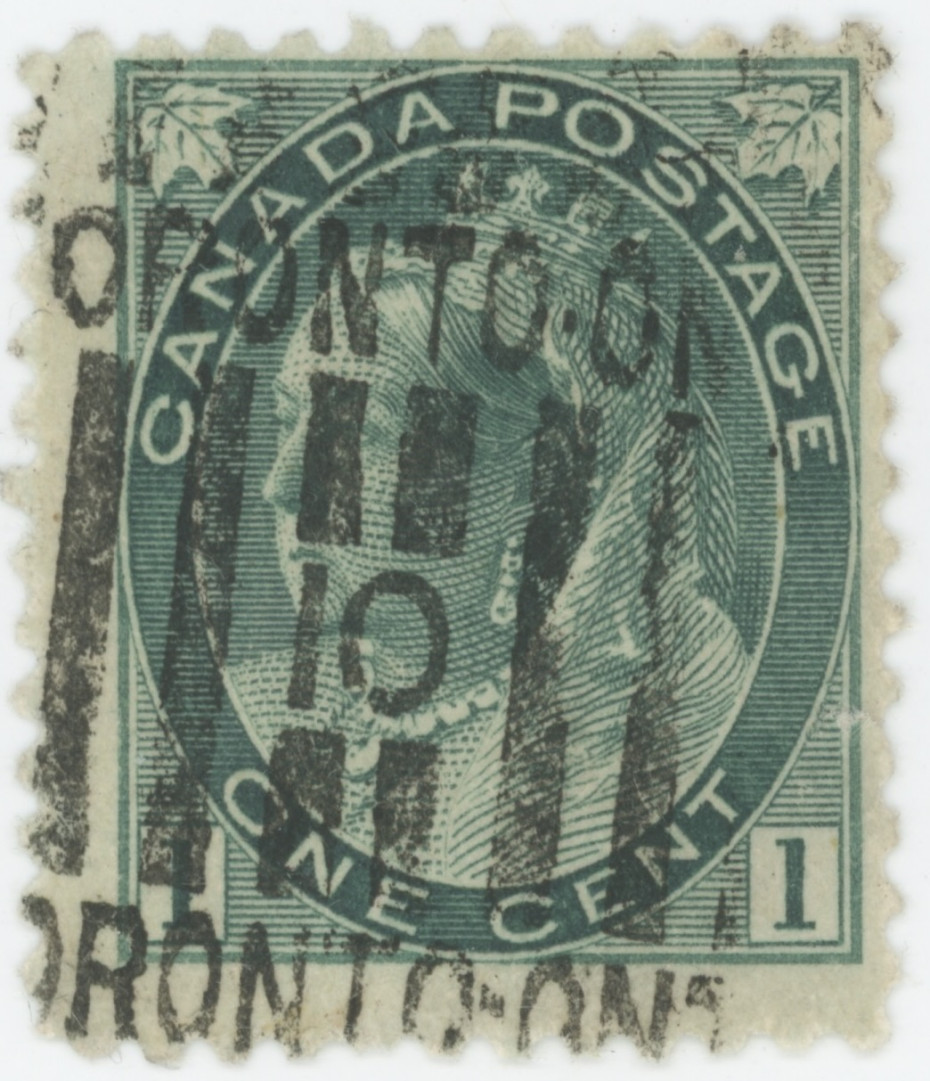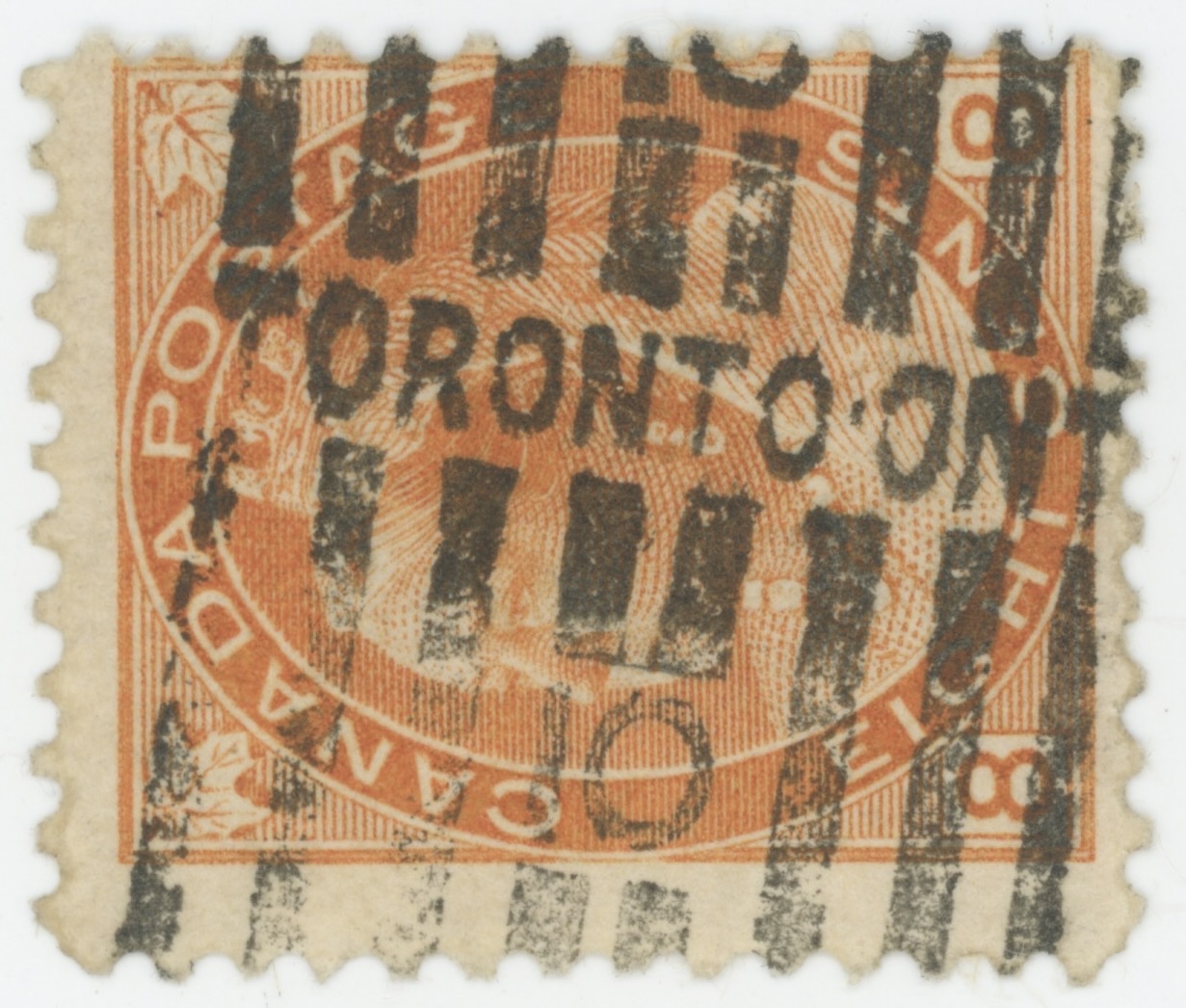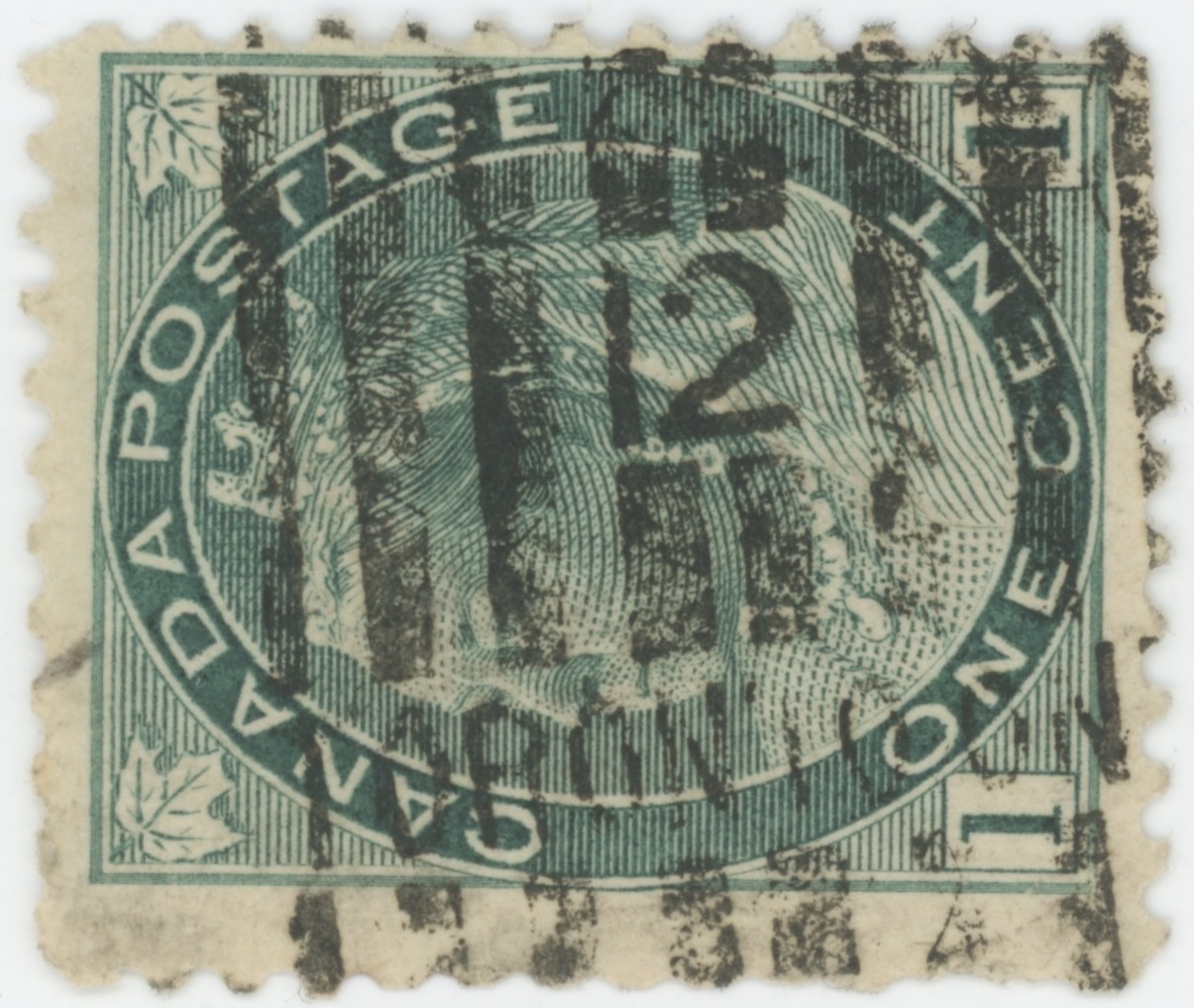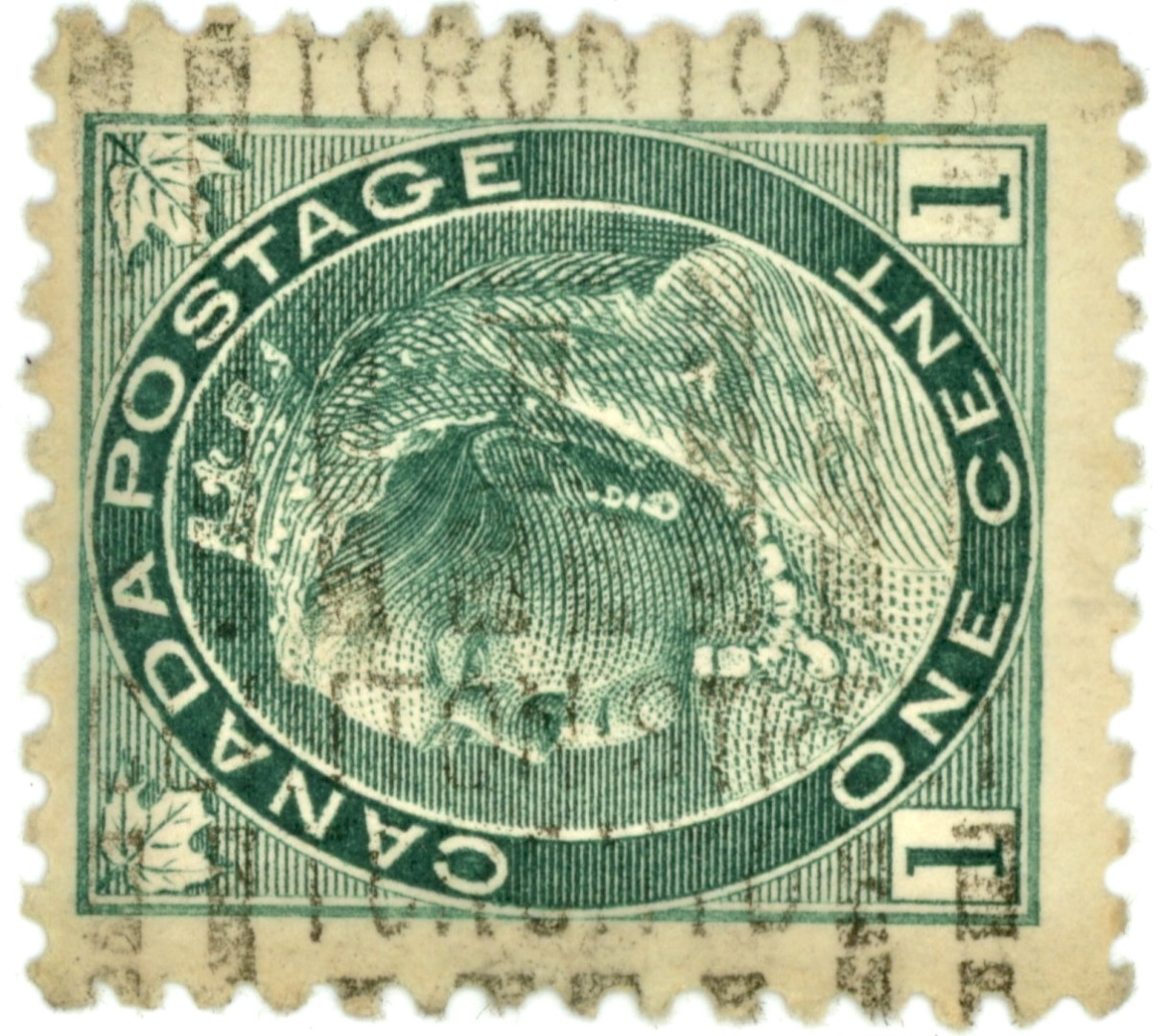
One of my collecting interests are Roller Cancellations ... Toronto Roller Cancellations in particular. Here is one of my latest acquisitions.
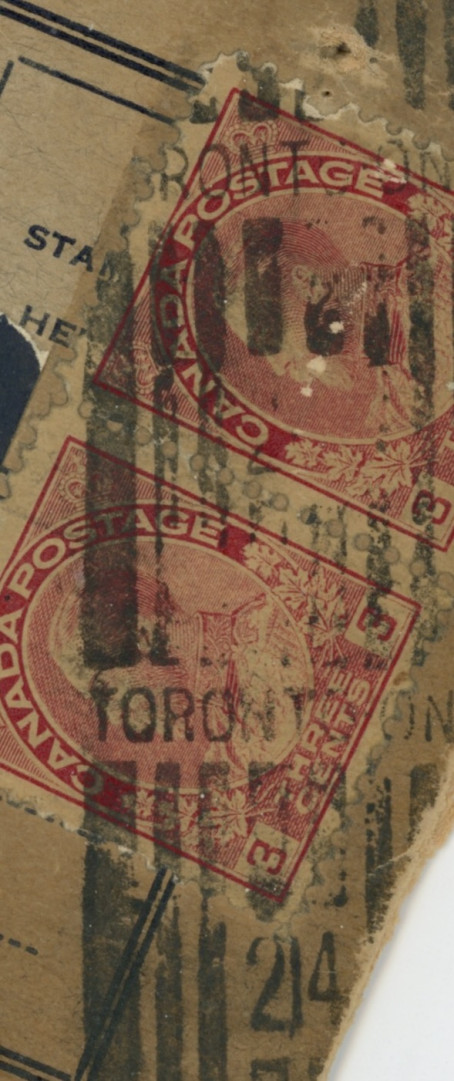
It's tied to what appears to be two 3c carmine (Die I) KGV Admirals issued on December 18, 1923 (Unitrade / Scott 109). The eight-bar interrupted roller has TORONTO-ONT / 24 ... Smythies Type IV. Roller cancels are always fascinating for the almost infinite number of varieties. On this one, for example, the letters are 3mm, the interrupted space is 7mm and the numerals are 5mm. More typically, the numerals are 4mm high.
In an April 1967 article in BNA Topics (Vol. 24, No. 4, p. 111), Walker & Hill summarized that variations can be found in:
1. The size of the overall imprint can vary even on the same roller
2. The width of the bars.
3. The height and style of the letters.
4. The height and style of the numbers.
5. The width of the interruption.
Source: bnaps.org/hhl/Topics/BNA%20Topics%2C%20Vol.%2024%2C%20No.%204%2C%20April%201967%2C%20Whole%20No.%20254.pdf
As for this example, it appears to have been the top of a small box, a commercial pharmaceutical package sent from:
Ingram & Bell Limited
Pharmaceuticals
Physician's, Hospital and Laboratory Supplies
Toronto, Canada
to a Dr. P. T. Bowlby, V.S., Tweed, Ont. (V.S.=Veterinary Surgeon). Dr. Bowlby, as it turns out, was also the postmaster of Tweed between 1912 and January 8, 1941.
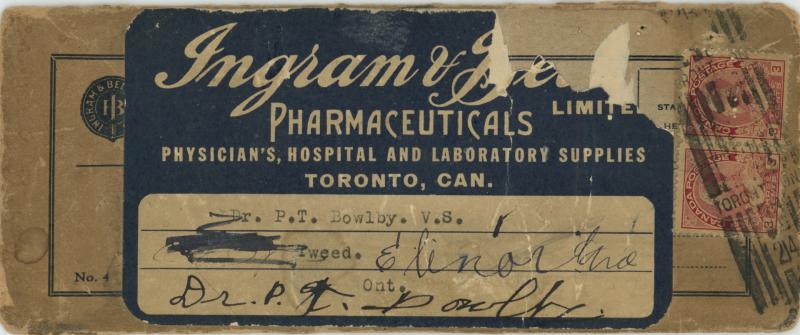
Six cents is consistent with the postage on a parcel in the six-ounce range under the rule that the maximum charge on parcels up to 8 oz. was 1c per ounce. That provision is confirmed in the 1925–26 Canada Official Postal Guide.
It is always a challenge to date a Canadian Roller Cancel ... since the 3c carmine was first issued on December 18, 1923, the item cannot be earlier than late 1923. Beyond that ... who knows? I would date the use broadly to the mid-to-late 1920s. I'm still looking for a LRD for Toronto roller No. 24 or the end date for the one-cent-per-ounce parcel rate.
Cheers, Hugh
It's tied to what appears to be two 3c carmine (Die I) KGV Admirals issued on December 18, 1923 (Unitrade / Scott 109). The eight-bar interrupted roller has TORONTO-ONT / 24 ... Smythies Type IV. Roller cancels are always fascinating for the almost infinite number of varieties. On this one, for example, the letters are 3mm, the interrupted space is 7mm and the numerals are 5mm. More typically, the numerals are 4mm high.
In an April 1967 article in BNA Topics (Vol. 24, No. 4, p. 111), Walker & Hill summarized that variations can be found in:
1. The size of the overall imprint can vary even on the same roller
2. The width of the bars.
3. The height and style of the letters.
4. The height and style of the numbers.
5. The width of the interruption.
Source: bnaps.org/hhl/Topics/BNA%20Topics%2C%20Vol.%2024%2C%20No.%204%2C%20April%201967%2C%20Whole%20No.%20254.pdf
As for this example, it appears to have been the top of a small box, a commercial pharmaceutical package sent from:
Ingram & Bell Limited
Pharmaceuticals
Physician's, Hospital and Laboratory Supplies
Toronto, Canada
to a Dr. P. T. Bowlby, V.S., Tweed, Ont. (V.S.=Veterinary Surgeon). Dr. Bowlby, as it turns out, was also the postmaster of Tweed between 1912 and January 8, 1941.
Six cents is consistent with the postage on a parcel in the six-ounce range under the rule that the maximum charge on parcels up to 8 oz. was 1c per ounce. That provision is confirmed in the 1925–26 Canada Official Postal Guide.
It is always a challenge to date a Canadian Roller Cancel ... since the 3c carmine was first issued on December 18, 1923, the item cannot be earlier than late 1923. Beyond that ... who knows? I would date the use broadly to the mid-to-late 1920s. I'm still looking for a LRD for Toronto roller No. 24 or the end date for the one-cent-per-ounce parcel rate.
Cheers, Hugh
Hugh MacDonald, Wolfe Island
Member: BNAPS. PHSC, MPHS, FPHS, CSS
Auxiliary Markings Club, Postal Stationery Society, British Postmark Society,
Civil Censorship Study Group
ArGe Deutsche Feldpost: 1914-1918 e.V.
Member: BNAPS. PHSC, MPHS, FPHS, CSS
Auxiliary Markings Club, Postal Stationery Society, British Postmark Society,
Civil Censorship Study Group
ArGe Deutsche Feldpost: 1914-1918 e.V.