

19-09-2025, 10:08 AM
I got this recently in one of Roy's online auctions, one of a lot of six such covers.
...
Here's a commercial cover from October 29, 1813.

It is addressed to:
Monsieur
Monsieur p re
Castres St Martin
Par Limoux
A Chalabre
That would appear to be Father [père] Castres St. Marin. And, it would also appear that the cover was sent to Chalabre a small town near Limoux. In 1806, Limoux had a population of 5,723. Both are in the Languedoc Region in southern France
The linear hand-stamp on the cover indicates that it was mailed from Prades in Département 65. This is supported by the letter inside which indicates that it was written by a gentleman named Mulló in Jujols (near Prades) on October 29, 1813.
Chalabre is just over 100km north of Jujols which would explain the manuscript 4 on the cover. The postage in 1813 would have been 4 décimes for a single letter weighing less than 6g traveling between 100 and 200km.
As far as I can tell, M. Mulló writes in a French with a non-standard orthography and, perhaps, a bit of Occitan influence thrown in.
Jajols Le 29. 8bre 1813
Monsieur p.re Castres jaj Reseu da l’atre
Du 21. Courant mois, et je vous Dire pour
Seffinir; De faire Venir a checher ma laine
de plus prait posible que l’ous pouvrai, par le
Voiturier, quil vous plairà, en portant une d’aitre
de Votre nom; Et celà ma bien instruiti
pour une otre foi Soit qui Se Soit
je Vous Salüe
Mulló
There is also a margin note on the left side that reads:
Montant
de pois. á
laine,
a ppe [ = à apposer]
6 . q.t [ = 6 quintats]
Which is to say, “Father Castres, I have received the letter of the 21st of this month, and I write to tell you, so as to settle the matter, to have my wool collected as soon as possible, by whichever carrier you think best, presenting my letter in your name. And this has taught me well for another time, whoever it may concern. I salute you, Mulló”
And, the margin note is “Amount of weight to be entered: 6 quintals [~ 600 kg]. Which is a lot of wool!

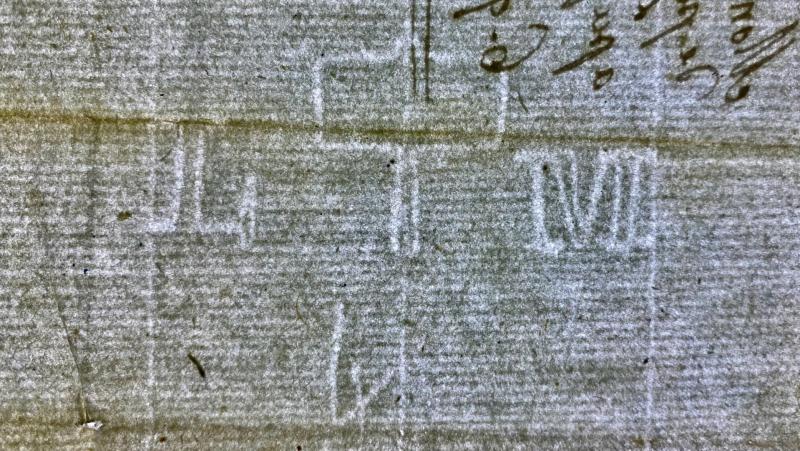
It was written on good quality laid paper and has a watermark. It looks like an L and M with a papermaker mallet in between. I'm still working on identifying it. I'm assuming it's a local paper.
Cheers, Hugh
PS: Meanwhile, following the debacle in Russia, Napoleon is struggling in his war with the Sixth Coalition.
...
Here's a commercial cover from October 29, 1813.
It is addressed to:
Monsieur
Monsieur p re
Castres St Martin
Par Limoux
A Chalabre
That would appear to be Father [père] Castres St. Marin. And, it would also appear that the cover was sent to Chalabre a small town near Limoux. In 1806, Limoux had a population of 5,723. Both are in the Languedoc Region in southern France
The linear hand-stamp on the cover indicates that it was mailed from Prades in Département 65. This is supported by the letter inside which indicates that it was written by a gentleman named Mulló in Jujols (near Prades) on October 29, 1813.
Chalabre is just over 100km north of Jujols which would explain the manuscript 4 on the cover. The postage in 1813 would have been 4 décimes for a single letter weighing less than 6g traveling between 100 and 200km.
As far as I can tell, M. Mulló writes in a French with a non-standard orthography and, perhaps, a bit of Occitan influence thrown in.
Jajols Le 29. 8bre 1813
Monsieur p.re Castres jaj Reseu da l’atre
Du 21. Courant mois, et je vous Dire pour
Seffinir; De faire Venir a checher ma laine
de plus prait posible que l’ous pouvrai, par le
Voiturier, quil vous plairà, en portant une d’aitre
de Votre nom; Et celà ma bien instruiti
pour une otre foi Soit qui Se Soit
je Vous Salüe
Mulló
There is also a margin note on the left side that reads:
Montant
de pois. á
laine,
a ppe [ = à apposer]
6 . q.t [ = 6 quintats]
Which is to say, “Father Castres, I have received the letter of the 21st of this month, and I write to tell you, so as to settle the matter, to have my wool collected as soon as possible, by whichever carrier you think best, presenting my letter in your name. And this has taught me well for another time, whoever it may concern. I salute you, Mulló”
And, the margin note is “Amount of weight to be entered: 6 quintals [~ 600 kg]. Which is a lot of wool!
It was written on good quality laid paper and has a watermark. It looks like an L and M with a papermaker mallet in between. I'm still working on identifying it. I'm assuming it's a local paper.
Cheers, Hugh
PS: Meanwhile, following the debacle in Russia, Napoleon is struggling in his war with the Sixth Coalition.
Hugh MacDonald, Wolfe Island
Member: BNAPS. PHSC, MPHS, FPHS, AMGCC, CSS
Auxiliary Markings Club, Postal Stationery Society, British Postmark Society,
Civil Censorship Study Group
ArGe Deutsche Feldpost: 1914-1918 e.V.
