
05-08-2025, 11:07 AM
Cross-writing is when a writer gets to the bottom of a page, or the space available for writing on a postcard, and has more to say. So, he or she turns the page ninety degrees and keeps writing over what has already been written. It one of my collecting interests ... and I'm always looking for new examples.
Here's one I found recently.
It was sent from Hardwick, Vermont to Laconia, New Hampshire on July 16 probably in 1908.
The date is not clear on the duplex cancel .. it looks to me like it's either 1903 or 1908. However, this is a divided back postcard and that format was not allowed in the United States until March 1, 1907. So, I'm going to go with 1908.
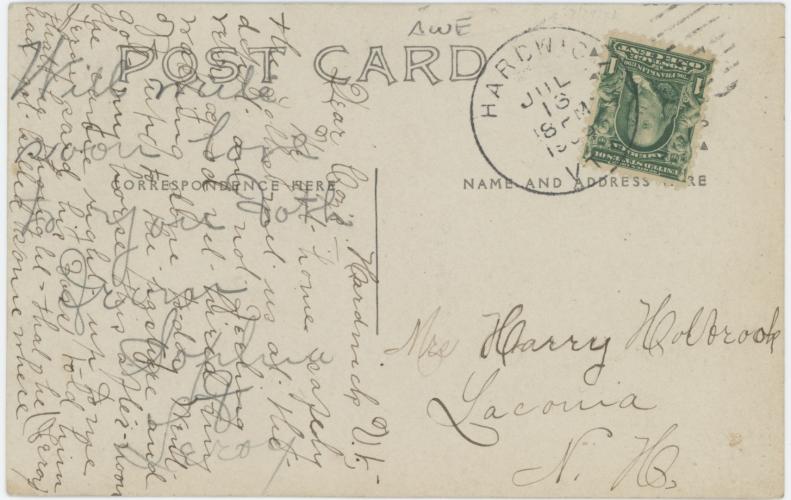
Hardwick was a small granite-quarry town on the Boston and Maine railway line. The card was addressed to Mrs. Harry Holbrook. 'Cuz' in the salutation confirms a family connection.
Laconia was about 115 miles south of Hardwick.
Stamp:
US - Benjamin Franklin
Issued on February 3, 1903
1c, green
Sc. 300
The then current domestic postcard rate was 1c.
Cancel: Single Ring Duplex
Outer ring - HARDWICK / VT
Inner - JUL / 13 / 8 PM / 190[8]
Postcard:
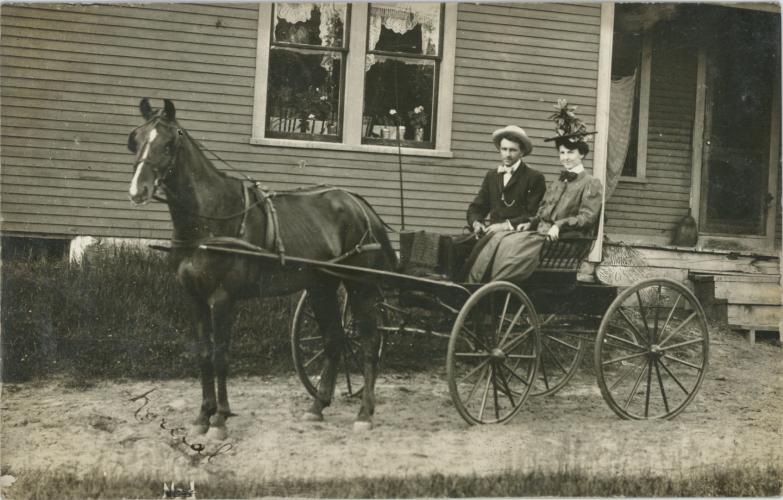
A privately published Real Photo Postcard (RPPC) showing a well-dressed couple in a four-wheeled open runabout (buggy). [Sophie and Leroy? See below]
Written on the photo, is the word 'Kernal' ... probably the name of the horse. The man is wearing a straw hat, a sack suit and a bow-tie. The woman is wearing a 'merry-widow' hat with a plume. Kodak introduced the 'Brownie' camera around 1900 and US postal regulations allowed privately printed RPPCs by 1904.
Message:
The message is cross written to add more content but, to make it easier to read, the horizontal portion of the message was written in pen with a dark ink and the vertical portion was written in pencil.
The message reads:
[vertical]
Hardwick Vt.
Dear Coz,
We got home safely. The folks met us at the depot.
Am not feeling very good yet - tired from walking home today.
Went up to the pasture and got my horse this afternoon;
He came right up to me.
Leroy said his boss told him that he thought he had got killed somewhere
[horizontal]
Will write soon.
Love to you both.
From Sophie and Leroy.
Cheers, Hugh
Here's one I found recently.
It was sent from Hardwick, Vermont to Laconia, New Hampshire on July 16 probably in 1908.
The date is not clear on the duplex cancel .. it looks to me like it's either 1903 or 1908. However, this is a divided back postcard and that format was not allowed in the United States until March 1, 1907. So, I'm going to go with 1908.
Hardwick was a small granite-quarry town on the Boston and Maine railway line. The card was addressed to Mrs. Harry Holbrook. 'Cuz' in the salutation confirms a family connection.
Laconia was about 115 miles south of Hardwick.
Stamp:
US - Benjamin Franklin
Issued on February 3, 1903
1c, green
Sc. 300
The then current domestic postcard rate was 1c.
Cancel: Single Ring Duplex
Outer ring - HARDWICK / VT
Inner - JUL / 13 / 8 PM / 190[8]
Postcard:
A privately published Real Photo Postcard (RPPC) showing a well-dressed couple in a four-wheeled open runabout (buggy). [Sophie and Leroy? See below]
Written on the photo, is the word 'Kernal' ... probably the name of the horse. The man is wearing a straw hat, a sack suit and a bow-tie. The woman is wearing a 'merry-widow' hat with a plume. Kodak introduced the 'Brownie' camera around 1900 and US postal regulations allowed privately printed RPPCs by 1904.

Message:
The message is cross written to add more content but, to make it easier to read, the horizontal portion of the message was written in pen with a dark ink and the vertical portion was written in pencil.
The message reads:
[vertical]
Hardwick Vt.
Dear Coz,
We got home safely. The folks met us at the depot.
Am not feeling very good yet - tired from walking home today.
Went up to the pasture and got my horse this afternoon;
He came right up to me.
Leroy said his boss told him that he thought he had got killed somewhere
[horizontal]
Will write soon.
Love to you both.
From Sophie and Leroy.
Cheers, Hugh
Hugh MacDonald, Wolfe Island
Member: BNAPS. PHSC, MPHS, FPHS, AMGCC, CSS
Auxiliary Markings Club, Postal Stationery Society, British Postmark Society,
Civil Censorship Study Group
ArGe Deutsche Feldpost: 1914-1918 e.V.