

As planned, I spent the weekend at the Toronto Antiquarian Book Fair. It's one of my favourite annual outings. I came home with several books, including one that I think will be particularly useful in my postal history research. 'The Later Court Hands in England from the Fifteenth to the Seventeenth Century', by Sir Hilary Jenkinson (1882–1961).
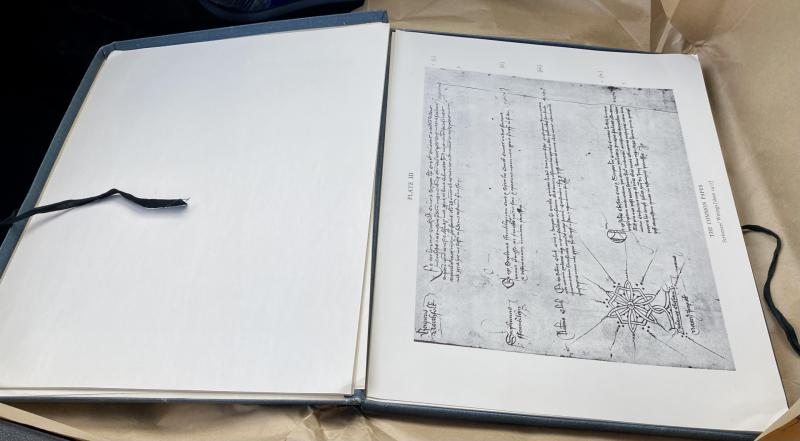
What particularly attracted me was the accompanying large-format portfolio containing 44 facsimile plates of historical manuscripts and five sheets of comparative alphabets.
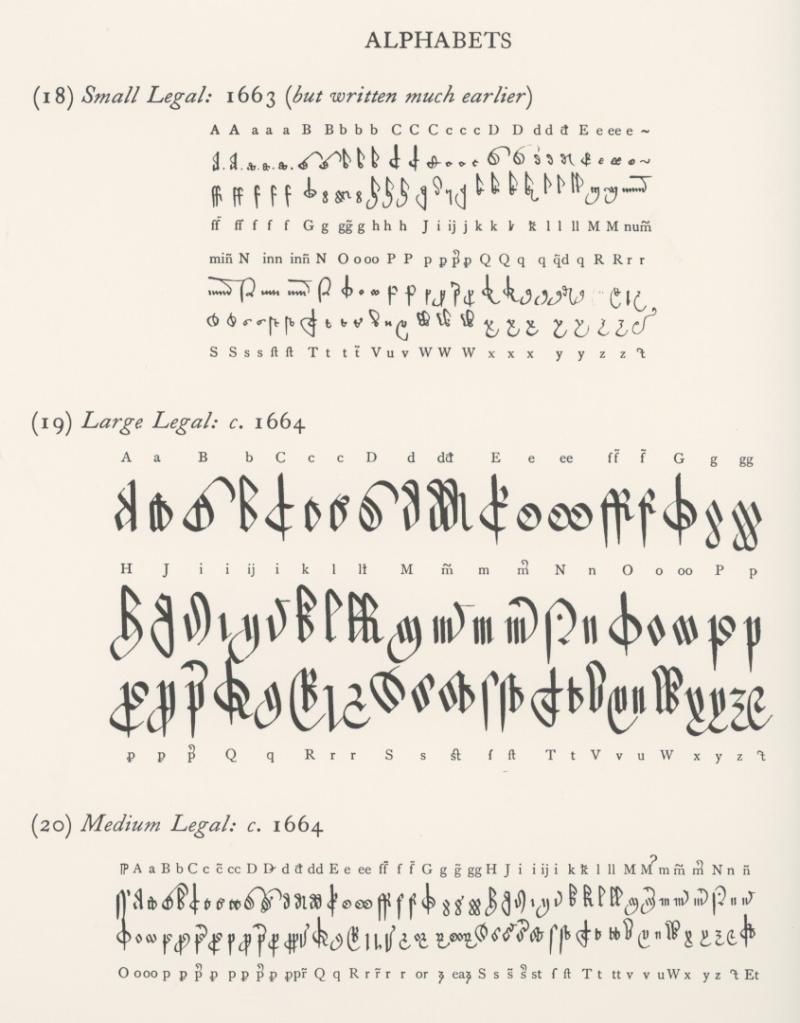
The alphabet sheets trace the development of several English writing traditions, including bastard hand, secretary hand, chancery hand, legal hands and, eventually, round hand.
I have a longstanding interest in palaeography. In recent years, especially, because of the problems I encounter deciphering addresses, endorsements and correspondence on older postal-history material. Much of my collecting involves 19th and early 20th century European military and occupation mail, particularly German and Austrian field post.
This acquisition speaks to a question that has interested me for some time: Why did English and German handwriting develop so differently? Both traditions have roots in the Gothic handwriting of medieval Europe. However, beginning in the fifteenth and sixteenth centuries, they increasingly followed different paths.
In England, the older Gothic-derived secretary and administrative hands gradually came under the influence of humanistic italic writing. By the later seventeenth century, mixed and rounded scripts were emerging that would eventually lead to the English round hand familiar from eighteenth- and nineteenth-century correspondence.
In the German-speaking areas, meanwhile, the Gothic cursive tradition developed into Kurrentschrift, or Kurrent. It was already well established by the late sixteenth century and continued to evolve through the following centuries.
By the nineteenth century, the contrast was striking. English correspondence generally employed rounded, flowing letterforms, while German correspondence retained the distinctive, often angular forms of Kurrent.
There are qualifications, of course. England retained some of its older Gothic-derived legal hands well into the eighteenth century. German writers also employed Latin handwriting, sometimes switching between Latin script and Kurrent within the same document.
For anyone else interested in early English handwriting, there is an excellent free online resource from Cambridge University:
English Handwriting 1500–1700: An Online Course ... www.english.cam.ac.uk/ceres/ehoc
Two other resources cover the German tradition: University of Zurich — German Kurrent ... www.adfontes.uzh.ch/en/tutorium/schriften-lesen/schriftgeschichte/deutsche-kurrentschrift
and, the University of Vienna — History of Kurrent and German Handwriting ... https://gonline.univie.ac.at/erste-schri...geschichte
...
One item that I did not come home with was this rather interesting Victorian Book Post mailing box, addressed to John A. Roebuck, Esq., M.P., Ashley Place, Pimlico, London.
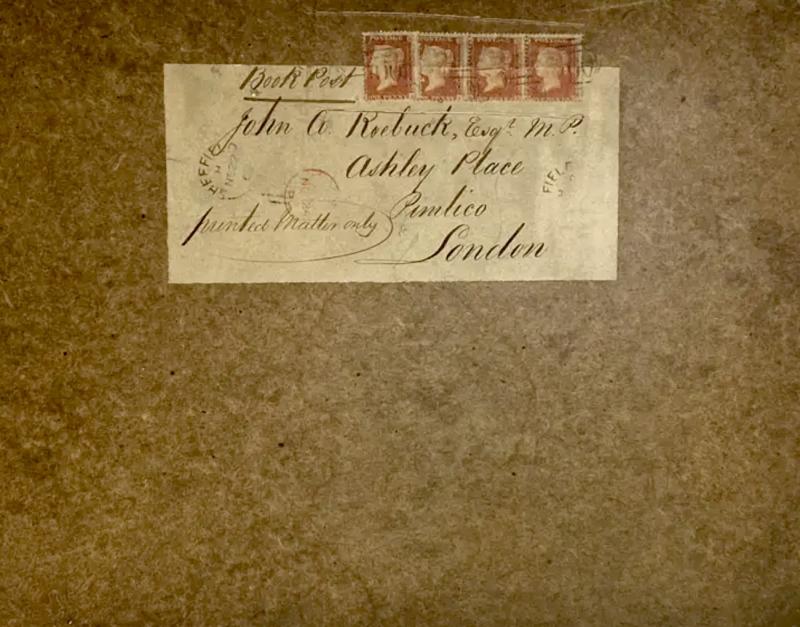
There are four penny reds and the box appears to have been posted in Sheffield. I couldn't quite make out the year when I was there ... my guess is 1859 or 69. However, in 1859 Roebuck WAS representing Sheffield as an MP. In 1869 he was out of office. That doesn't mean he wasn't still getting mail from that location ... but, 1859 seems a better bet.
The British Book Post was introduced on February 21, 1848, at the suggestion of Rowland Hill. It was intended to facilitate the inexpensive circulation of books, particularly through lending libraries. The original rate was sixpence per pound, and the regulations were initially quite restrictive.
The fourpenny franking was interesting, when I got home this morning I did some checking.
June 11, 1855 – February 28, 1866: 4d paid for a packet weighing over 8 ounces but not exceeding 16 ounces.
March 1, 1866 – September 30, 1870: 4d paid for over 12 ounces but not exceeding 16 ounces.
From October 1, 1870: The rate became ½d for each 2 ounces, so 4d paid for over 14 ounces but not exceeding 16 ounces.
Since I wasn't able to confirm the date, I can't establish which one applied. If my 1859 guess is correct, it would be the first periods.
Roebuck represented Sheffield in Parliament from 1849 to 1868 and again from 1874 until his death in 1879.
What was inside? That is where things become rather interesting.
Roebuck (1802–1879) had spent part of his childhood in Upper Canada, along the St. Lawrence near Prescott and Brockville (Not very far from where I live). He later became an important advocate for constitutional reform in Lower Canada, serving as the London representative of the Legislative Assembly and working closely with Louis-Joseph Papineau -- a rather storied figure in Canadian history.
The dealer was offering the box together with several other items associated with Roebuck, including an 1838 manuscript outlining a proposed history of the United States, an autobiographical manuscript dated 1878, photographs and other illustrations. There is no demonstrated evidence that the box originally carried any of these particular manuscripts.
Although the box is marked printed matter only, my understanding is that the Book Post regulations did not necessarily exclude handwritten manuscripts. The British Postal Guide of July 1868 permitted written books and papers, provided they did not contain prohibited personal correspondence and could be opened for inspection.
Why didn't I buy it?
I was principally interested in the postal history ... the book rate box ... and the dealer wanted $3,200 for the entire collection. The manuscripts and other associated material certainly had historical value but drove the price far beyond my level of interest for the postal element of the collection. A pity, really. It would have been an interesting addition. So now, I'm looking for another example of book post.
As good as the fair was, the best part of the weekend was seeing my daughter and having a vegetable roti at Island Foods (smile) ... the best roti in Canada IMHO.
Cheers, Hugh
What particularly attracted me was the accompanying large-format portfolio containing 44 facsimile plates of historical manuscripts and five sheets of comparative alphabets.
The alphabet sheets trace the development of several English writing traditions, including bastard hand, secretary hand, chancery hand, legal hands and, eventually, round hand.
I have a longstanding interest in palaeography. In recent years, especially, because of the problems I encounter deciphering addresses, endorsements and correspondence on older postal-history material. Much of my collecting involves 19th and early 20th century European military and occupation mail, particularly German and Austrian field post.
This acquisition speaks to a question that has interested me for some time: Why did English and German handwriting develop so differently? Both traditions have roots in the Gothic handwriting of medieval Europe. However, beginning in the fifteenth and sixteenth centuries, they increasingly followed different paths.
In England, the older Gothic-derived secretary and administrative hands gradually came under the influence of humanistic italic writing. By the later seventeenth century, mixed and rounded scripts were emerging that would eventually lead to the English round hand familiar from eighteenth- and nineteenth-century correspondence.
In the German-speaking areas, meanwhile, the Gothic cursive tradition developed into Kurrentschrift, or Kurrent. It was already well established by the late sixteenth century and continued to evolve through the following centuries.
By the nineteenth century, the contrast was striking. English correspondence generally employed rounded, flowing letterforms, while German correspondence retained the distinctive, often angular forms of Kurrent.
There are qualifications, of course. England retained some of its older Gothic-derived legal hands well into the eighteenth century. German writers also employed Latin handwriting, sometimes switching between Latin script and Kurrent within the same document.
For anyone else interested in early English handwriting, there is an excellent free online resource from Cambridge University:
English Handwriting 1500–1700: An Online Course ... www.english.cam.ac.uk/ceres/ehoc
Two other resources cover the German tradition: University of Zurich — German Kurrent ... www.adfontes.uzh.ch/en/tutorium/schriften-lesen/schriftgeschichte/deutsche-kurrentschrift
and, the University of Vienna — History of Kurrent and German Handwriting ... https://gonline.univie.ac.at/erste-schri...geschichte
...
One item that I did not come home with was this rather interesting Victorian Book Post mailing box, addressed to John A. Roebuck, Esq., M.P., Ashley Place, Pimlico, London.
There are four penny reds and the box appears to have been posted in Sheffield. I couldn't quite make out the year when I was there ... my guess is 1859 or 69. However, in 1859 Roebuck WAS representing Sheffield as an MP. In 1869 he was out of office. That doesn't mean he wasn't still getting mail from that location ... but, 1859 seems a better bet.
The British Book Post was introduced on February 21, 1848, at the suggestion of Rowland Hill. It was intended to facilitate the inexpensive circulation of books, particularly through lending libraries. The original rate was sixpence per pound, and the regulations were initially quite restrictive.
The fourpenny franking was interesting, when I got home this morning I did some checking.
June 11, 1855 – February 28, 1866: 4d paid for a packet weighing over 8 ounces but not exceeding 16 ounces.
March 1, 1866 – September 30, 1870: 4d paid for over 12 ounces but not exceeding 16 ounces.
From October 1, 1870: The rate became ½d for each 2 ounces, so 4d paid for over 14 ounces but not exceeding 16 ounces.
Since I wasn't able to confirm the date, I can't establish which one applied. If my 1859 guess is correct, it would be the first periods.
Roebuck represented Sheffield in Parliament from 1849 to 1868 and again from 1874 until his death in 1879.
What was inside? That is where things become rather interesting.
Roebuck (1802–1879) had spent part of his childhood in Upper Canada, along the St. Lawrence near Prescott and Brockville (Not very far from where I live). He later became an important advocate for constitutional reform in Lower Canada, serving as the London representative of the Legislative Assembly and working closely with Louis-Joseph Papineau -- a rather storied figure in Canadian history.
The dealer was offering the box together with several other items associated with Roebuck, including an 1838 manuscript outlining a proposed history of the United States, an autobiographical manuscript dated 1878, photographs and other illustrations. There is no demonstrated evidence that the box originally carried any of these particular manuscripts.
Although the box is marked printed matter only, my understanding is that the Book Post regulations did not necessarily exclude handwritten manuscripts. The British Postal Guide of July 1868 permitted written books and papers, provided they did not contain prohibited personal correspondence and could be opened for inspection.
Why didn't I buy it?
I was principally interested in the postal history ... the book rate box ... and the dealer wanted $3,200 for the entire collection. The manuscripts and other associated material certainly had historical value but drove the price far beyond my level of interest for the postal element of the collection. A pity, really. It would have been an interesting addition. So now, I'm looking for another example of book post.
As good as the fair was, the best part of the weekend was seeing my daughter and having a vegetable roti at Island Foods (smile) ... the best roti in Canada IMHO.
Cheers, Hugh
Hugh MacDonald, Wolfe Island
Member: BNAPS. PHSC, MPHS, FPHS, CSS
Auxiliary Markings Club, Postal Stationery Society, British Postmark Society,
Civil Censorship Study Group
ArGe Deutsche Feldpost: 1914-1918 e.V.
(This post was last modified: 16-11-2026, 06:24 PM by Hugh.)
Member: BNAPS. PHSC, MPHS, FPHS, CSS
Auxiliary Markings Club, Postal Stationery Society, British Postmark Society,
Civil Censorship Study Group
ArGe Deutsche Feldpost: 1914-1918 e.V.